This insight explains why not doing is harder than doing, even when motivation is strong, and why holding back often drains willpower faster than taking action.

Humans stand out from other species because we can keep a goal in mind and work toward it over time. When we have a goal, we need to protect it. Sometimes that means taking action, and other times, holding back.
- You take actions to get closer to your goal.
- You avoid actions to keep your goal safe.
In both situations, we depend on willpower and self-control.
But in everyday life, willpower tends to fail more often when we try not to do something than when we try to take action. For example, it can feel easier to go for a jog than to resist a tempting dessert in the fridge.
Why does this happen if willpower is supposed to be just one skill?
The reason is that the brain treats taking action and holding back very differently, even though we call both willpower.
This insight explains why “not doing” is biologically harder than “doing”, and how this difference can quietly weaken our self-control.
- Willpower works differently for doing and not doing—the brain favors action over inhibition.
- Dopamine supports goal-aligned actions, but often strengthens the very impulses you try to resist.
- Resisting an urge relies on a type of self-control that is easily weakened when you are tired, stressed, or hungry.
- Impulses grow stronger in no-go situations because reward prediction activates before control.
- The best way to use willpower is to set up your surroundings so you avoid temptation, instead of trying to resist it directly.
What Willpower Actually Does
Willpower means resisting short-term temptations in the service of long-term goals.
 To make this happen, willpower does three main things:
- It helps you keep your goal in mind
- It guides you to choose actions that match your goal
- It helps you hold back urges that go against your goal
All three of these functions play a role when you act or hold back. But our biology does not support them all equally.
Taking action is easier for us than holding back, and this difference is the main reason why willpower often fails.
Goal Stabilization: “Go” vs “No-Go” Situations
When you use willpower, your goal needs to stay active in your mind, especially in your working memory. This goal serves as a reference point. You compare each thought or action to it to see if it helps or gets in the way.
The prefrontal cortex keeps this goal active by repeatedly firing specific neurons, with strong support from dopamine.
But dopamine affects how goals are stabilized in different ways, depending on whether the goal is to take action or avoid something.
Two scenarios, one long-term goal
Let’s say your long-term goal is to stay healthy.
You might face two types of challenges:
- Action challenge: “I should go for a jog.”
- Restraint challenge: Seeing a sugary drink in the refrigerator.
In both situations, your brain focuses on your long-term goal and creates a smaller, related goal:
At first, these challenges might seem the same. But in your brain, they work differently.
Why “Doing” goals are stable
Examples of action-based goals include:
- Go for a jog
- Write the article
- Finish the task.
These types of goals have three main advantages.
- First, they match up with motor programs. These goals align with clear action sequences already stored in the basal ganglia.
- Second, dopamine helps support these goals. Dopamine is especially good at stabilizing action-related goals because it is developed to boost our behavior.
- Third, these goals come with a sense of reward in advance.
- The brain expects things like:
- Satisfaction
- Energy
- Mood elevation
and releases dopamine ahead of time. When this happens, the brain’s image of the goal gets stronger.
Because of this, action goals are:
- Easier to keep active
- More resistant to distraction
- Strengthened by expecting a reward (positive feedback)
Even though our working memory is limited, it can still easily hold onto:
- The long-term goal (be healthy)
- The action sub-goal (go jogging)
Since these goals fit well together, they support each other rather than getting in the way.
Why “Not Doing” goals are fragile
Restraint goals are weaker by nature. The brain cannot directly represent the absence of an action.
Instead, the brain has to picture the action it is trying to avoid.
For example, to follow the goal “Don’t drink the sugary drink,” the brain must keep several things in mind:
- Long-term goal: Be healthy
- Action representation: Drink the sugary drink
- Suppression rule: Don’t do it
This setup tends to fail for two main reasons.
1. Dopamine does not support “Don’t do it” very well
- The action “drink the sugary drink” has:
- A clear motor program
- A strong reward history
- The rule “don’t do it” has:
- No motor component
- No intrinsic reward
 As a result, dopamine makes the unwanted action more stable in the brain than the rule that is supposed to stop it.
2. Working memory lets go of weakest goal first
Working memory is limited. It can only hold a few things at once. When you are trying to resist something, your working memory has to juggle several things at the same time:
Multiple goals
The tempting action
Emotional and reward signals
Conscious inhibition
When the brain is overloaded, it drops the weakest idea first. Usually, that is the abstract rule: “don’t do it.”
Once this rule fades, the temptation takes over. This happens not because of a lack of willpower, but because of how the brain prioritizes things.
Fatigue makes this problem worse. Not getting enough sleep or feeling mentally tired weakens working memory and self-control.
The difference between “doing” and “not doing” is not just about working memory. Even if you know your goal, your brain still has to choose what to do in the moment. This is where another imbalance shows up.
The same brain chemical that helps keep goals stable, dopamine, also decides which actions get energy, urgency, and priority. This system is designed to start actions, not to hold them back.
To see why restraint feels hard even when your goal is clear, we need to look at dopamine itself and why it is made for action, not for stopping action.
- Brain imaging studies have found that when goals are framed as “don’t do X,” they cause weaker and less stable activation in the prefrontal cortex compared to goals framed as “do Y” (Bunge & Wright, 2007).
- Experiments on working memory and self-control have also shown that rules framed in a negative way fade more quickly when people are under mental strain, while thoughts about the tempting action stay active (Wegner, 1994).
- When cognitive demand goes up, the brain is more likely to let go of the rule that stops the impulse before it lets go of the impulse itself. This means that self-restraint is fragile not only emotionally, but also biologically.
Dopamine: Built for Action, Not for Inhibition
At its core, dopamine does two main things:
- It energizes us to take action
- It helps us predict rewards
Put simply:
Dopamine asks, “Is this worth acting on right now?”
It doesn’t tell us not to act.
Dopamine and “Doing”
When there’s a clear action that has led to good results before, dopamine activity goes up. As dopamine rises, your brain is more likely to start and keep doing that action.
For example: jogging
- You have a clear plan—like getting dressed and moving your body.
- You know the reward: feeling energized, accomplished, or in a better mood.
- Your brain expects a good result.
As dopamine increases, your brain leans toward taking action. It feels easier to get started—not because the task is simple, but because your brain is helping you move ahead.
When what you’re doing matches your goal:
- It feels easier to get started
- It also feels more natural to keep going
Dopamine and “Not Doing”
Resisting an action is much harder for the brain than doing something.
Not doing something usually misses two things that dopamine likes:
- A positive reward (usually an unpleasant reward)
- A clear plan for what to do with your body
Because of this, dopamine doesn’t naturally help us hold back. There’s nothing in the system that pushes your brain to say, “don’t do it.”
To hold back, your brain has to fight its usual habits:
- You have to hold back urges driven by dopamine or override them
- Your prefrontal cortex needs to stay active to keep you in control
- You have to keep suppressing tempting impulses, not just do it once
This process relies heavily on executive attention, which is the kind of focus you control on purpose. But it has its own limits.
Executive attention is:
- Energy-demanding for the brain
- Limited in how much it can manage at one time
- Quick to fatigue, especially under stress
(This kind of effortful focus is part of the larger Attention and Focus system. It helps determine how long you can stay in control before your mental energy runs out.
When you’re holding back, your executive attention has to juggle three tough jobs at once:
- Dial down the signals from dopamine that push you to act
- Hold conflicting goals in mind (”wanting it” vs “not doing it”)
- Actively block reward-seeking impulses as they come up
Since all three use the same limited mental energy, it’s easier for self-control to break down than for action to stop—especially if you’re stressed, emotional, tired, or haven’t slept well.
This is why “not doing” often fails even when motivation and intention are strong.
Since dopamine is built to energize action rather than restraint, its influence becomes most visible when impulses arise. This is where the difference between “go” and “no-go” situations stops being theoretical and starts to shape real behavior.
To understand why impulses are easier to act on than to resist, we need to look at how impulse control works in “go” versus “no-go” situations.
Impulse Control: “Go” vs “No-Go” Situations
Dopamine naturally supports impulses because they usually share two main features:
- A clear action is attached to them
- A history of reward, often immediate and reliable
This is why impulses have a strong presence in the brain.
This effect is even stronger in “no-go” situations, when you try not to act. Many impulses you try to resist, like eating sugary foods, are high-reward behaviors. The brain predicts the reward automatically, often before you make a conscious choice, which leads to a rise in dopamine.
Higher dopamine does not help you hold back. Instead, it makes the temptation stronger by reinforcing the brain’s signal for the action you want to avoid.
As dopamine increases, the urge feels stronger, clearer, and harder to ignore, until it finally overcomes your self-control.
Why restraint becomes even harder in certain situation
Restraint often fails not just because of temptation, but also because of your body’s and brain’s state at the time.
In many “no-go” situations, the action you are resisting also satisfies a biological need.
For example:
- When you are hungry, a sugary drink or snack feels physically necessary
- When you are sleep-deprived, rest or stimulation feels urgent
In these situations, the brain goes into survival mode. Fast, reward-seeking systems take over, and the prefrontal cortex loses some control. This makes it very hard to hold back, even if you know your long-term goal.
This is not a lack of discipline. It is a loss of control that depends on your current state.
- Controlled studies show that when people are hungry, their performance on tasks that require inhibition and self-control drops significantly, often by about 30 to 40 percent compared to when they have eaten (Gailliot et al., 2007).
- Brain-imaging studies show that when people are hungry, the prefrontal cortex is less active and the brain’s reward circuits become more sensitive. This makes tempting cues feel more urgent and harder to ignore (Goldstone et al., 2009; Volkow et al., 2011).
- Participants usually do not say they feel less motivated or that their goals have changed. Instead, it is the brain’s ability to enforce self-control that changes.
Why “Go” situations face less impulse pressure
“Go” situations rarely create this much internal conflict.
- The action usually supports the goal
- Dopamine works with you, not against you
- There is less competition between reward and control systems
As a result, impulses are easier to manage, and willpower feels stronger, even though your brain is working the same way.
Using This Knowledge to Strengthen Willpower
Understanding how the brain handles “doing” and “not doing” leads to a clear conclusion:
The best way to protect your willpower is to avoid situations where you have to say no whenever you can.
Resisting temptation is hard for our brains. Each time you have to say no, your brain has to fight off cravings, juggle different goals, and hold back impulses all at once. This quickly uses up your mental energy and makes it easier to slip up.
The healthy life vs sugary drink example
Consider the goal of living a healthy life.
If you keep a sugary drink in your fridge, your brain has to keep dealing with several things:
- The long-term goal: stay healthy
- The tempting action: drink the sugary drink
- The suppression rule: don’t drink it
As long as the sugary drink is there, your brain keeps expecting a reward from it. This makes the craving stronger and makes it harder to stick to your rule of not drinking it, especially if you’re hungry or tired, since your brain sees sugar as quick energy.
Now compare this with a different setup.
If there’s no sugary drink in the fridge and you’ve already eaten healthy food, things are different. There’s nothing tempting you, and your body isn’t looking for quick calories.
Your brain doesn’t have to hold anything back. Your goal of staying healthy stays strong, and you don’t use up your willpower.
Design beats restraint
This illustrates a crucial principle:
- Inhibition-based control relies on fragile executive effort
- Environment-based control removes the need for inhibition
When you set up your environment to avoid situations where you have to say no, you save mental energy and let your willpower work best when you’re taking positive steps toward your goals.
You don’t build strong willpower by always fighting temptation. Instead, you make it easier by setting up your life so you don’t have to resist as often.
Willpower and self-control work together as one system that helps you reach your goals and manage your impulses. This insight examined a key weakness in that system: situations in which success depends on holding back rather than taking action.
In the bigger picture of willpower and self-control, these situations show how our biology, brain chemistry, and mental state affect self-regulation. Knowing about this limitation can help you use willpower where it is most effective and set up your life so you do not have to rely on restraint as often.
Frequently Asked Questions About Willpower
References


 To make this happen, willpower does three main things:
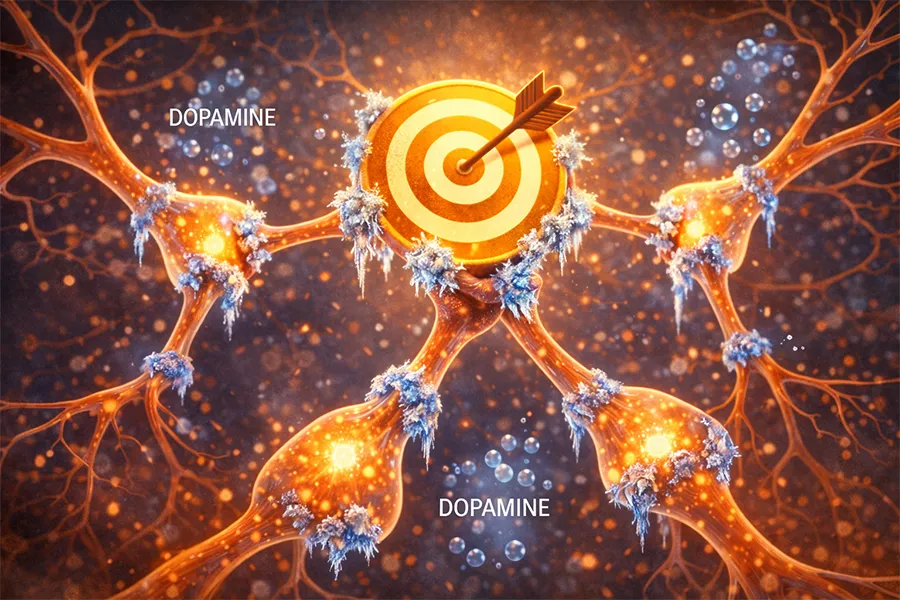 The prefrontal cortex keeps this goal active by repeatedly firing specific neurons, with strong support from dopamine.
 As a result, dopamine makes the unwanted action more stable in the brain than the rule that is supposed to stop it.
 When the brain is overloaded, it drops the weakest idea first. Usually, that is the abstract rule: “don’t do it.”
 Dopamine naturally supports impulses because they usually share two main features:
 In many “no-go” situations, the action you are resisting also satisfies a biological need.
 Now compare this with a different setup.