
A Practical, Science-Based Path to Rewire Your Mind
- Last Updated: January 2026
It was a typical Monday morning in the crowded subway, where the air buzzed with a palpable tension. Commuters scrolled through their phones, their eyes darting from one notification to another. A blinking deadline screamed urgency on one screen, while another buzzed with relentless calendar alerts.
This is the modern chase: goals, targets, and achievements setting the pace. Yet, while pursuing these ambitions, our minds often get overwhelmed by the noise, pressure, and the weight of expectations from society and from the goals themselves.
It’s normal to want to achieve things. Goals are important. The real issue is the way we go after them.
Many people chase their goals with tension and force. In doing so, they often sacrifice their mental well-being as a hidden cost. This toll can be easily overlooked but comes with consequences that resonate deeply, such as missing cherished family moments or seeing their creativity become stifled.
Over time, this sacrifice can lead to stress, confusion, and burnout, overshadowing the victories of meeting targets and external success. The journey from who you are now to who you want to be can start to feel confusing and tiring.
This often happens because many people don’t have a calm, mindful, focused, and self-directed mind. This kind of mindset quietly helps high achievers in many areas. It may not guarantee success, but it lets you keep working without feeling overwhelmed inside.
Most people already get this idea on some level. Still, very few actually train their minds like this. Why is that?
It’s because they see it as
Just another goal.
Just another task.
Just another burden.
They don’t want to have one more thing to chase.
But here’s the truth:
A calm, mindful, focused, and self-directed mind isn’t a goal. It is the alignment of mental skills that helps you move toward your goals with less struggle. It simply makes things easier.
You aren’t born with this kind of mind. You build it through practice.
Not by pushing yourself too hard.
Not by putting more pressure on yourself.
Not by giving up on your goals.
You develop these skills as you work toward your goals, not instead of them.
The benefits of better mind skills add up quietly over time. Even small changes can make your daily life feel easier. Just a 1% improvement in how you focus, manage yourself, or act on purpose can improve everything you do.
Your mind works for you. If it’s untrained, life feels harder. If it’s skilled, life goes more smoothly. When you improve your mind’s skills, reaching your goals becomes calmer, clearer, and more sustainable.
The Benefits of a Calm, Mindful, Focused, and Self-Directed Mind
Having a calm, focused, mindful, and self-directed mind doesn’t make life instantly easy, but it does make things more manageable. You’ll still deal with pressure, responsibilities, and uncertainty. The key difference is how your mind handles these challenges.
Imagine your mind as the steering wheel of a car. If it’s loose or unsteady, even the best engine won’t help much. You might drift, overcorrect, and feel tense all the time.
That exact mind can make life’s path smooth. It simply helps you steer your life in the direction you choose. You can stay on track, adjust your pace, and choose when to slow down or speed up. This sense of control builds confidence, clarity, and inner stability.
Now, let’s look at the benefits of having a calm, focused, mindful, and self-directed mind.
Life feels less noisy
A calm mind quiets the constant internal chatter. You think more clearly, worry less about unimportant things, and minor problems no longer feel overwhelming.
This doesn’t mean your emotions go away. Instead, emotions come and go without taking over your attention. As a result, you feel calmer.
You use your energy more efficiently
When your mind is in the right state, your mental energy flows in one clear direction instead of being scattered.
Mental energy is one of your most valuable resources. With a calm, focused, and self-directed mind, you use your energy on purpose rather than waste it on distractions, indecision, or extra effort.
In this state:
- Tasks feel more manageable.
- Mistakes decrease.
- Learning becomes deeper and smoother.
- Work flows with less resistance.
You get more done not by working harder, but by using less energy on things that don’t matter.
This way, you stop feeling busy all day without knowing what you actually achieved. Your effort starts to turn into real progress.
You respond instead of reacting
With a calm and mindful mind, you can pause before you act, even when situations are tempting or emotional. Your decisions become more thoughtful and grounded. Instead of reacting on impulse, you start to think before you act.
Over time, your reactions turn into thoughtful responses. You feel less inner struggle, and your actions feel more intentional instead of forced.
Mindfulness is important here. It gives you a brief but powerful pause between your impulses and your actions.
In that pause, you can:
- Notice distractions before they pull you in.
- Catch emotional reactions early.
- Choose responses that align with your intentions rather than automatic habits.
This pause is where you gain control. It’s also where self-direction starts.
You act with intention, not pressure
If you pay attention to your daily life, you’ll notice that most actions are driven by pressure instead of intention. Work is often done to meet deadlines. Household tasks are done because they demand attention. Learning happens because of exams, targets, or expectations.
Even rest often feels rushed. Meals go by quickly, breaks are timed, and relaxation seems limited. Over time, this ongoing pressure leads to mental fatigue and exhaustion.
A self-directed mind helps break this pattern.
It helps you decide:
- What truly deserves your attention.
- What can safely be ignored?
- When to rest without guilt.
- When to push forward with purpose.
- How to make clearer, more grounded decisions
Discipline and good habits are essential here. They reduce chaos and add structure, so your actions can flow without constant urgency. When your workflow is organized, you don’t feel as much pressure. You stop reacting to every demand, notification, or expectation.
Instead, your actions start to match what really matters to you. Life feels less rushed, more intentional, and easier to keep up with.
Well-being becomes a natural outcome
When you protect your attention, your actions become more intentional. As your actions become more intentional, your habits get stronger. When your habits are steady, your stress goes down.
Happiness and well-being aren’t forced. They come naturally when your mind stops working against itself.
In short
A calm, mindful, focused, and self-directed mind helps you:
Think clearly
Act intentionally
Waste less energy
Feel more in control of your life
Live with less inner conflict
This isn’t about being perfect. It’s about creating a mind that helps your life, not makes it more challenging.
Many people believe their biggest problem is a lack of motivation to change their lives.
The Real Problem Isn’t Motivation
Have you heard yourself say any of these?
“I know what to do, but I can’t start.”
“I lose focus too quickly.”
“I try for a few days, then everything falls apart.”
“I feel lazy or undisciplined.”
“I feel distracted and unhappy all the time.”
Many people think these struggles mean they lack motivation. But most of the time, motivation isn’t the real issue. Motivation is just a feeling. It comes and goes with your mood, stress, and what’s happening around you. It’s not a skill you can count on when things get tough.
Real, lasting progress comes from building strong mental skills. Motivation can help you start, but skills help you keep going. This is the difference that many people overlook.
People who get things done don’t depend on motivation. Instead, they use clarity, focus, self-control, and decision-making skills. These make taking action feel natural, not forced.
If you asked a successful person what pushed them to achieve something important, they probably wouldn’t mention inspiration or motivation. Usually, they just noticed what needed to be done and started working.
They might not explain it this way, but that mindset is supported by mental skills they’ve practiced over time, whether or not they knew it.
Every calm, focused, and self-directed person has at least one strong mental skill, with other skills helping out too.
These skills can:
- Reduce hesitation.
- Improve decision-making.
- Prevent emotional overload.
- Make effort feel easier.
They help you make choices calmly, without any fuss.
Motivation, on the other hand, depends on your emotions. It fades when your feelings change. You can’t count on it when you’re stressed, unsure, or tired. That’s why chasing motivation often leaves people frustrated.
Mindit-Rewire doesn’t teach you to feel motivated. Instead, it helps you build mental skills so you don’t have to rely on motivation as much.
When your skills are strong, taking action feels natural. When your skills are weak, motivation by itself is never enough.
Mind Skills You Need
A skill isn’t just a feeling or a single thought that instantly changes your life. Instead, a skill is something you can train. It’s a set of pathways in your brain that you can strengthen over time.
Strengthening these skills reshapes how your mind functions. It is similar to upgrading a laptop’s RAM, memory, and processor. The same tasks become easier, faster, and more reliable.
You develop mind skills by practicing them, getting feedback, and using them often. Unlike motivation or mood, skills stay with you even when your emotions change. They help you stay steady when your feelings go up and down.
Each mind skill supports the brain’s higher cognitive abilities. Together, they determine how effectively you handle daily life, overcome challenges, and reach your long-term goals.
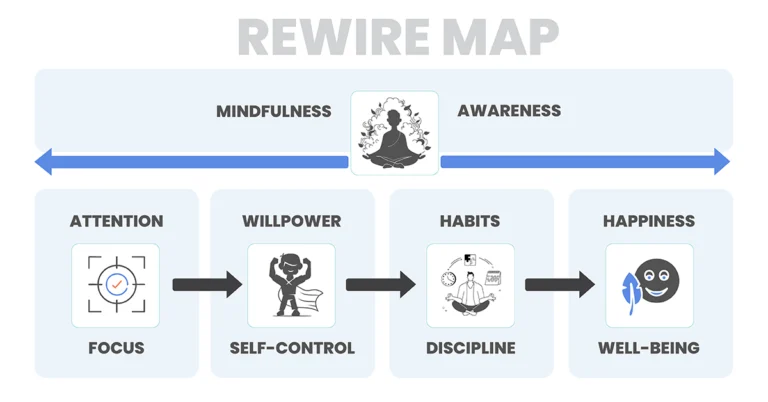
Mindit-Rewire teaches five key mind skills:
- Attention & Focus
- Willpower & Self-Control
- Habits & Discipline
- Mindfulness & Awareness
- Happiness & Well-Being
These skills are all connected. When you get better at one, it often helps you improve the others, too.
Let’s take a closer look at:
- What each skill is
- How each skill can help you
- How you can improve these skills
1. Attention & focus
Attention and focus mean directing your mental energy toward what matters most right now. They guide your thoughts and help you engage more deeply.
When your attention is steady, you think more deeply. Ideas connect more easily, and learning becomes more effective.
Why attention and focus are important
When attention and focus are well developed, you can:
- Choose what deserves your attention.
- Maintain it without constant effort.
- Protect it from unnecessary distractions.
This skill helps you use your mental energy more efficiently.
Instead of wasting energy on unimportant things, attention helps you filter out distractions and focus on what truly matters. This makes your mind feel lighter and work better.
Attention and focus are some of the most valuable mental skills because they shape how you think about life.
Key benefits of focus and attention
Enhanced learning and memory
Focus helps you retain information long enough to process and understand it. When your attention is steady, you learn more deeply, not just quickly. Concepts connect, details stick, and your memory improves over time. This applies to studying, work skills, and personal growth.
Improved problem-solving
Clear attention leads to clear thinking. When your mind isn’t constantly switching, you can hold a problem in place, look at it from different angles, and work through solutions. Focus helps you see patterns, notice mistakes, and understand complex ideas, rather than reacting quickly.
Greater efficiency
Focus helps you avoid wasting mental effort. Instead of starting and stopping, your attention stays on the task until you make real progress. This saves time, lowers frustration, and helps you feel less busy without results.
Better goal achievement
Achieving goals takes steady, repeated effort. Focus lets you return to the same goal each day without losing your way. Instead of just relying on motivation, attention keeps your energy aimed at what you want to achieve.
Better decision-making
Focused attention helps you tell what matters from what doesn’t. It lets you calmly consider important information instead of being distracted by emotions, noise, or urgency. Your decisions become clearer because your mind is not overwhelmed.
Present-moment awareness
Attention keeps you involved in what you are doing right now. Conversations feel more meaningful, work becomes more interesting, and daily activities seem less rushed and more purposeful. This helps reduce mind-wandering and makes everyday life more satisfying.
Skill mastery over time
Every skill needs steady mental effort. Focus gives you the attention you need to practice, improve, and get better over time. Without focus, practice stays shallow. With focus, your progress builds up.
Simply put, focus and attention decide how well you use your time, energy, and mind. When you train your attention, life feels clearer, calmer, and more purposeful.
How focus connects to other skills
Focus helps your willpower by lowering mental fatigue.
Focus makes it easier to build and keep good habits.
Focus lets you be more mindful in your daily life.
Focus helps steady your emotions and supports your well-being.
That’s why improving your focus often leads to positive changes in many parts of your life at the same time.
The way of attention & focus
You don’t improve attention and focus just by trying harder. They get better when you understand how attention works, why it slips, and what helps it stay strong.
Attention is shaped by how your brain responds to new things, stress, mental effort, and your surroundings. Without this understanding, people often try to force focus, which only leads to tiredness.
But just understanding isn’t enough. Focus grows through steady, practical training in daily life.
That’s why Mindit-Rewire separates:
- Insight: how attention and focus function
- Guides: research-backed ways to train and protect them over time
2. Self-control & willpower
Willpower means guiding your actions even when you feel distracted, emotional, or tempted. It is the primary tool you use for self-control.
Stronger willpower leads to better self-control. Willpower is not something you are born with or stuck with—it changes and can run low at times.
Many people think they lack self-control because of personal weakness. In truth, self-control often fails because it is under constant pressure, and untrained willpower can be fragile.
Why willpower feels weak under pressure
Pressure uses up your mental energy. When you feel stressed, tired, overwhelmed, or emotional, your brain goes into survival mode.
In that state:
- Short-term relief becomes more attractive.
- Long-term goals feel distant.
- Impulses feel harder to resist.
That is why self-control often fails at the end of the day, during stressful times, or when you have too many decisions to make. This is your nervous system’s way of handling overload.
The myth of “Just Trying Harder”
A lot of people try to fix self-control problems by simply pushing themselves harder.
They tell themselves:
“I just need more discipline.”
“I should be stronger.”
“Other people can do this. Why can’t I?”
But this approach often backfires. Pushing harder adds more pressure but does not give you more ability. It can lead to more frustration, self-criticism, and mental tiredness.
Self-control gets better not by forcing it, but by making things less stressful, setting up your life so good choices are easier, and supporting your willpower.
Key benefits of self-control & willpower
Consistent action over time
Self-control helps you keep going even when you do not feel motivated. Instead of acting only on your feelings, you stick to your plans again and again. This steady effort is what turns goals into real results.
Reduced impulsive behavior
When your self-control is stronger, you can pause between feeling an urge and acting on it. You react less to distractions, cravings, emotions, or outside pressure. This means you make fewer choices you regret and act more on purpose.
Better stress management
As your self-control improves, it becomes easier to manage your emotions. You are less likely to feel overwhelmed by stress, frustration, or anxiety. This helps you stay calm during tough times rather than letting tension build.
Improved focus and persistence
Willpower helps you focus when tasks are hard or uncomfortable. It lets you stick with challenges long enough to make progress instead of giving up. Over time, this builds your resilience and mental strength.
Stronger habits and routines
Self-control is essential when you are starting new habits. It helps you repeat actions until they become automatic. Once a habit is set, it takes less effort to keep it going.
Clearer decision-making
When your self-control improves, you make decisions based more on your long-term values than on impulse. You can pause, think through your options, and pick what aligns with your goals, rather than just what feels easy right now.
Greater sense of personal agency
As your self-control gets stronger, you trust yourself more. You feel more able to guide your actions and shape your life. This sense of control lowers self-doubt and builds absolute confidence.
When you build this skill, effort feels easier, choices are clearer, and you can count on making steady progress.
How they fit into the bigger system
Self-control and willpower are most effective when you support them with other skills, instead of relying on them alone.
Focus helps you notice impulses early.
Habits reduce the need for constant restraint.
Mindfulness creates space between urge and action.
Well-being stabilizes energy and emotional balance.
When you have these supports, self-control feels easier and more dependable.
The way of self-control & willpower
Self-control is not something you are born with or a sign of moral strength. It is a skill shaped by your attention, stress, energy, and how many decisions you face. If you do not understand these factors, you might blame yourself and try to push harder, but that often makes willpower weaker, not stronger.
Science-backed insights help explain why self-control and willpower fluctuate and why they falter under pressure. This understanding takes away guilt and brings clarity.
Self-control and willpower get stronger when you support and manage them rather than using them up all the time.
That is why Mindit-Rewire focuses on:
- Insight: how self-control actually works in the brain
- Guides: practical systems that reduce strain and improve willpower
3. Habits & discipline
Habits are actions you do almost automatically, without much thought. Discipline is behaving in an orderly way. It involves creating a system that you can stick to.
Habits are the skeleton that strengthens discipline. Many people believe discipline is about making yourself do hard things every day. In fact, the most disciplined people depend more on strong habits than on constant effort.
Key benefits of habits & discipline
Reduced mental effort
Habits take away the need to keep deciding what to do. When your actions become automatic, your mind stops arguing with itself. This helps you feel less tired and makes daily tasks easier.
Consistency without motivation
Good habits help you keep moving forward, even when you are not feeling motivated. You do things because they are part of your routine, not just when you feel inspired. This steady effort leads to lasting change.
Protection of willpower
Habits mean you do not have to use self-control all the time. When important actions become automatic, you save your willpower for moments that really need it. This helps you avoid burnout and feeling overwhelmed by choices.
Stable progress over time
When discipline is backed by habits, you make steady progress toward your goals. Instead of working hard for a short time and then stopping, you move forward slowly and can keep it up.
Better focus and structure
Habits give your day a clear structure. This helps you avoid distractions and makes it easier to focus, since you do not have to keep deciding what to do next.
Resilience during stressful periods
When life gets busy or stressful, habits help you stay steady. Routines make it easier to keep up with important things like work, study, exercise, or rest, even during tough times.
Stronger sense of self-direction
When your habits match your values, your actions start to show the kind of person you want to become. You do not have to push yourself as much, and your behavior feels more natural.
Simply put, habits and discipline let you live on purpose without working so hard. They help turn your good intentions into actions you can count on, and make it easier to do the right thing again and again.
How habits fit into the bigger system
Habits do not work in isolation
Other mind-skills make habit formation easier.
Focus makes habits easier to start.
Willpower supports habits during early formation.
Mindfulness helps you notice habit loops.
Well-being keeps habits sustainable.
Habits and discipline empower other skills
- Any skill can become automatic or almost automatic. Take willpower, for example. It can be tough to keep up your willpower all day. But when you build habits, you can train your willpower until it feels natural. Then, you have it when you need it most.
- This concept applies to focus and mindfulness as well.
That is why habits are powerful, but they are always connected to the rest of your mind. In Mindit-Rewire, habits are not strict routines. They are meant to make life smoother and easier, with less mental struggle.
The way of habits & discipline
Habits are not built through motivation. Habits form when you repeat actions, have a clear structure, and set up your environment to guide your behavior automatically.
If you do not understand how habits work, you might try to rely only on discipline. This often leads to being inconsistent and feeling burned out.
Research shows how habits start, why they last, and why they sometimes do not work. With this knowledge, you can shape your behavior instead of just trying to force it.
Discipline feels easier when you build habits step by step, so you do not have to depend on willpower as much.
That is why Mindit-Rewire separates:
- Insights: how habits and behavior loops work
- Guides: step-by-step ways to build habits that last
4. Mindfulness & awareness
Mindfulness means noticing what’s happening in your mind and body as it occurs, without reacting right away. Awareness helps you see your thoughts, emotions, urges, and habits before they take over.
People often misunderstand mindfulness. It’s not about clearing your mind, avoiding thoughts, or being passive. It’s about seeing things clearly.
If your awareness is low, you tend to go through life on autopilot. As your awareness grows, you gain more choices in how you respond.
You can practice mindfulness in many ways, such as meditation, yoga, or simply being mindful in daily life. Whichever method you choose, the benefits are powerful and unique.
Key benefits of mindfulness & awareness
Reduced automatic reactions
Mindfulness lets you notice your thoughts, emotions, and urges before you act on them. This helps you avoid reacting automatically and gives you more control over your responses.
Better emotional regulation
Awareness helps you feel emotions without letting them overwhelm you. Rather than pushing feelings away or getting lost in them, you learn to notice and handle emotions calmly.
Improved focus and attention recovery
Mindfulness teaches you to notice when your attention wanders and gently bring it back. This helps you stay focused and recover from distractions, whether you’re working, studying, or doing everyday tasks.
Greater self-understanding
When you’re aware, you start to see patterns in your behavior. You notice what causes stress, distraction, or avoidance. This understanding is key to making real changes.
Feel happy without a reason
Mindfulness and meditation can change your brain and its chemistry in positive ways. They help reduce emotional reactions and judgments, which boost natural feelings and brain chemicals that make you feel happier.
Increased mental clarity
When you observe your mind instead of letting it run nonstop, your thinking becomes clearer. You make decisions more calmly, and your mind feels less cluttered.
Mindfulness serves as the foundation that keeps everything balanced.
Mindfulness in daily life
Mindfulness isn’t just about sitting quietly or doing formal exercises.
It shows up when you:
- Notice tension while working.
- Recognize mental fatigue before burnout.
- Realize you are rushing without reason.
These small moments of awareness change your behavior more effectively than trying to force it. Mindfulness helps you use other skills in real life, not just in theory.
The role of mindfulness meditation
Mindfulness meditation is a proven way to build awareness on purpose.
In everyday life, we often only notice our awareness when something isn’t going well. Meditation gives you a safe space to practice noticing things before problems come up.
When you meditate mindfully, you’re not trying to control your thoughts or force yourself to feel calm. Instead, you’re practicing three basic skills:
- Noticing when attention drifts.
- Gently bringing it back.
- Observing thoughts and emotions without reacting.
- Become aware of every thought.
You can use these skills right away in your daily life.
Just like exercise makes your body stronger, mindfulness meditation builds your awareness. Even a little regular practice can make a real difference over time.
In Mindit-Rewire, mindfulness and meditation are seen as training tools, not beliefs. Their value comes from how they help you focus, manage emotions, and guide yourself in daily life.
How mindfulness fits into the bigger system
Mindfulness ties together and supports all your other mental skills.
It helps focus by noticing distractions early.
It supports willpower by exposing impulses.
It strengthens habits by revealing automatic patterns.
It protects well-being by reducing emotional overload.
Without awareness, your skills can fall apart when you’re stressed. With awareness, they adjust and stay strong.
The way of mindfulness & awareness
Research shows how mindfulness affects your attention, emotions, and actions. It explains why noticing things early can change what happens later.
You build awareness by practicing mindfulness and meditation regularly, both in daily life and through extra training if you want.
That’s why Mindit-Rewire provides:
- Insights: how awareness and mindfulness affect the mind.
- Guides: practical ways to develop mindfulness and awareness without spiritual framing.
5. Well-Being & happiness
People often see well-being and happiness as things they need to pursue. In fact, they show up more naturally when your mind is working well.
Trying to force happiness often leads to frustration. The more you chase it, the more it slips away.
Mindit-Rewire offers a different way.
Why happiness is not the starting point
Happiness is a feeling, not a skill. Feelings come and go, but skills last. Still, you can boost happiness with proven practices from science.
If your attention is scattered, stress is high, and your actions feel out of control, happiness becomes shaky, no matter how much you want it.
That’s why many people feel unhappy even if their lives seem successful. The real issue isn’t gratitude or mindset—it’s that the mind skills aren’t aligned.
How happiness and well-being emerge naturally
When your main mental skills work together, your mind feels calmer.
Focus helps quiet the mental chatter.
Self-control helps you avoid regret.
Good habits make daily life smoother.
Mindfulness helps you react less strongly to emotions.
As friction decreases, calm appears. You find meaning when you focus on what matters most. Satisfaction grows as your actions match your intentions over time.
You don’t have to force these experiences. They come naturally when your mind is well-trained.
Can happiness be improved directly?
Yes, you can take steps to boost happiness directly. Practices like gratitude, connecting with others, being kind, reflecting on meaning, and enjoying good moments can lift your mood and make life feel better. Research shows these really help, especially in the short and medium term.
But these happiness practices have limits. Without steady focus, self-control, and good habits, their effects don’t last.
It’s easy to lose a grateful thought if you get distracted.
A positive intention is hard to keep when you’re stressed.
A meaningful insight fades if your daily actions don’t support it.
That’s why people often feel better for a short time, then end up disappointed.
Mindit-Rewire doesn’t reject happiness practices. Instead, it weaves them in.
These practices work best when your mind has:
- Enough focus to stay with positive experiences.
- Enough self-control to repeat healthy behaviors.
- Enough awareness to notice emotional shifts.
- Enough structure to sustain change
Direct happiness techniques can boost your mood, but core mental skills help those good feelings stick around.
Key benefits of well-being & happiness
Greater inner calm
Well-being eases ongoing mental tension. When your mind isn’t weighed down by stress or conflict, calm becomes your normal state instead of something you have to chase.
Emotional stability
Rather than riding emotional ups and downs, well-being brings steadiness. You feel less reactive and more balanced, even when life gets tough.
Improved life satisfaction
Well-being is closely linked to how well your actions match your values. When your focus, actions, and values line up, life feels more meaningful and whole.
Better stress resilience
When you feel well, it’s easier to handle stress. You bounce back from setbacks faster and feel less overwhelmed.
Sustainable happiness
Happiness becomes steadier and more reliable. It doesn’t depend on outside success, excitement, or motivation. It lasts because it’s built on strong mental skills.
More enjoyment of everyday life
Well-being helps you enjoy everyday moments. Work, conversations, and rest all feel more satisfying because your mind is present, not rushed or distracted.
Simply put, well-being and happiness come naturally when your mind is working in harmony. They aren’t goals you have to force. They’re what’s left when mental friction goes down.
The way of well-being & happiness
You don’t get well-being and happiness by chasing after good feelings. They show up when your mental skills work together.
If you don’t get this, you might try happiness tricks that help for a bit but fade when things get tough.
Science shows that well-being depends on your attention, actions, emotional balance, and values. This turns happiness from something fragile into something steady.
Well-being improves when you train your mind holistically, not through quick fixes.
That’s why Mindit-Rewire focuses on:
- Insights: understanding what sustains well-being.
- Guides: building the skills that make happiness durable.
Start Where Your Pain Is
All skills are connected, so as you work on one, the others will become easier to build over time. Figure out what you need most and begin there.
- If you have trouble staying focused, begin by working on your Focus skills.
- If you find it hard to stay disciplined, start by building better Habits.
- If you often feel mentally tired, focus on the basics of Well-Being first.
- If you notice you react quickly to things, begin with Mindfulness.
- If you feel stuck, try working on your Willpower.
Use insights for knowledge and guides for methods.
How to Use Mindit-Rewire
Mindit-Rewire offers background knowledge and practical ways to build mental skills, all explained in clear, simple language.
You don’t have to hurry. Focus on making small, steady progress. Improving by just 1% each day adds up. Each small practice builds a skill. Over time, skills can change how you think and feel.
A calm, mindful, focused and self-directed mind will guide you in a new direction.
Mindit-Rewire isn’t about changing overnight. It’s about making slow, lasting changes that fit into your real life. Be patient as you build your skills and let the results come naturally.
Sources
- (2020). *Mindfulness and Behavior Change*. American Journal of Lifestyle Medicine 14(6), pp. 531-537.
- Kaufmann, M. (2021). *Projection Bias in Effort Choices*. arXiv:2104.04327.
- (2025). *The Psychology of Habit Formation for Leaders*. Rae Francis Consulting.
- Smith, K. S. & Graybiel, A. M. (2016). *Neurobiology of habit formation*. Dialogues in Clinical Neuroscience 18(1), pp. 33-43.
- (2009). *Hierarchically organized behavior and its neural foundations: A reinforcement learning perspective*. Cognition 113(3), pp. 262-280.
- Fox, K. C., Dixon, M. L., Nijeboer, S., Girn, M., Floman, J. L., Lifshitz, M., Ellamil, M., Sedlmeier, P. & Christoff, K. (2016). *Functional neuroanatomy of meditation: A review and meta-analysis of 78 functional neuroimaging investigations*. NeuroImage 169, pp. 362-378.
- (2023). *Individuals with High Mindfulness Are Better at Metacognitive Ability: A Latent Profile Analysis Approach*. PubMed.
- Desai, A. D. (November 4, 2025). *Retrain Your Brain's Reward System*. Psychology Today