
Most of us know the pattern: we start with a clear goal and lots of motivation, but then lose momentum when we get tired, stressed, or tempted. The difference between what we plan and what we actually do is a common struggle. People often sum it up with two words: willpower and self-control.
For a long time, people thought of them as a limited resource, like a muscle that gets tired the more you use it. If we lost self-control, it seemed like we just weren’t disciplined enough. But this idea doesn’t tell the whole story.
Recent studies in psychology and neuroscience show that self-control is more complicated than just trying harder. It depends on how our brains work, our emotions, our surroundings, our habits, and even our biology. People who seem “strong-willed” are not always pushing themselves. Instead, they use strategies to make things easier, save mental energy, and avoid constant struggle.
This Insight explores how willpower and self-control really work, why they sometimes fail, and what new research says about sticking to long-term goals. Learning how these things work is the first step to building self-control that lasts and feels less tiring.
- Willpower helps you make decisions in the moment, but self-control is built ahead of time, so you don’t have to depend on willpower as often.
- Willpower works in two ways: it helps you take action when things are tough, and it helps you hold back when you feel pressure.
- Self-control isn’t only about trying harder. It also depends on factors such as your sleep, stress, mood, habits, and surroundings.
- People who seem strong-willed often avoid constant struggles by planning ahead, cutting out distractions, and staying away from temptations.
- Long-term change happens when effort turns into habits and routines. This way, self-control starts to feel easier and less exhausting.
What is Willpower and Self-Control?
What is willpower?
Willpower is your ability to stay in control when your impulses try to lead you in another direction. It connects what you want to do with what you actually achieve.
It is like a struggle between the part of you that wants quick rewards, such as scrolling social media or eating cake, and the part that wants to be productive or healthy. When you feel tired, bored, or tempted, but still choose your long-term goal over a short-term pleasure, you are using willpower.
Psychologists describe willpower as the ability to resist short-term temptations to reach long-term goals. (Breazeale, 2012)
At its core, willpower is more than just thinking or wishing. It is about taking real action to resolve your inner conflict and move toward your goal.
The two forms of willpower
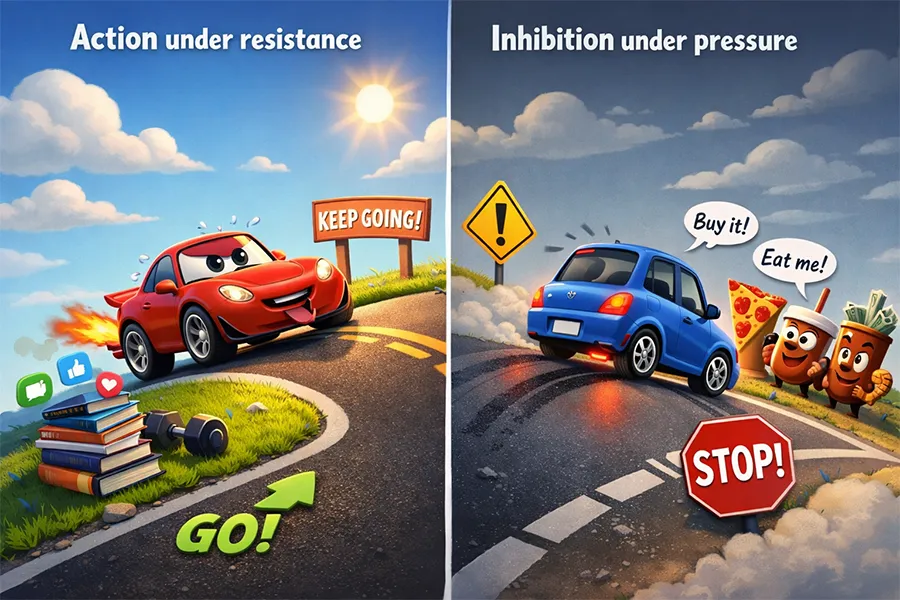
 Willpower shows up in two main ways:
- Action under resistance.
This means making yourself start or keep going on a task, even if you feel tired, bored, doubtful, or face outside challenges.
For example, you keep studying, even when you feel the urge to check social media, or you go to the gym even when you feel tired. - Inhibition under pressure.
This means holding yourself back from acting, even when you feel strong urges or pressure from others.
For example, you might resist eating junk food, avoid spending money on impulse, or keep calm during an argument.
One type of willpower helps you take action, and the other helps you hold back. Both require you to be aware of your choices and manage what you do.
Both forms depend on willpower, but the brain does not support them equally. Holding yourself back is often harder than taking action. This difference is not only psychological; it also comes from how dopamine, attention, and control systems work in the brain.
Willpower is about action
Willpower is not just about thinking, planning, or wanting to change. It is the ability to act on your intentions, even when it feels hard or uncomfortable.
Making a decision often feels easy. The real challenge comes afterward, when your body and mind resist following through.
For example, you may decide to go to the gym instead of sleeping longer. The decision itself feels light and satisfying. But the true challenge begins when you have to get out of bed, put on your shoes, and leave the house. Acting despite that resistance is willpower.
The same applies to resisting temptation. Suppose your goal is to lose weight, and you decide not to eat a piece of cake. The decision is simple at first. But as time passes, the urge intensifies. Your mind highlights how enjoyable the cake would be or how much energy it might give you. When you still choose not to eat it, you are exercising willpower.
Willpower works in these moments, when you resolve your inner conflict by taking action toward your goal, not just thinking about it. A decision only matters when you act on it.
Willpower alone is not mental strength
People often think willpower means being tough or having a strong character. In fact, it is a short-term way to control yourself, not a permanent trait. Even very successful people have days when their willpower is low (Roberts & Inzlicht, 2024).
Consider Albert Einstein, who reportedly struggled with distraction and lapses in focus during his work, a theme noted in multiple biographical accounts of his daily habits and working style (Isaacson, 2007)
Willpower is only one part of mental strength. It helps control impulses and stay aligned with goals, but it cannot by itself manage stress, regulate emotions, or sustain focus.
Real mental strength goes beyond just willpower. It involves skills such as managing your emotions, staying focused, being mindful, and adapting to change. These skills help you need them less often and make it work better.
Willpower works best when supported by a well-regulated mind, rather than being used as a standalone solution.
Willpower often feels like a struggle
Willpower helps you get past obstacles, but these obstacles are not always the same. The first challenge often comes from habits, emotions, or physical feelings. Each time, the obstacle can look different.
You may feel resistance because you are tired, sleepy, bored, stressed, or tempted by something more interesting. Although the behavior looks the same (“I don’t feel like doing this”), the cause is different each time. Without addressing these root causes, staying in control feels exhausting.
For example, before an exam, you might resist studying because you are physically tired—and manage to push through. Later, the same resistance returns, but now it is driven by sleep deprivation. A strategy that worked once may fail the next time, because the underlying problem has changed.
Obstacles can also come from outside: distractions, poor time structure, or constant interruptions. Each requires a different response.
Willpower feels hard because it is used to solve many different problems with just one approach. This is not a personal weakness. It is simply a natural limit of willpower.
That is why self-control systems, good habits, and a supportive environment are important. They lower the number of times you need to use willpower and help you make steady progress.
Willpower vs Self-Control
Willpower and self-control are often used interchangeably, but they refer to different parts of the same process.
You use willpower in moments of conflict. It is the mental effort to stick to your long-term goal when you feel an impulse or temptation. In short, it is a quick act of resisting and bringing your thoughts and actions back on track when your mind wants to go elsewhere.
Self-control, on the other hand, works before conflict happens. It helps you need willpower less often. This means planning your day, setting up your environment, and thinking ahead about when you might be tempted.
A helpful way to think about it is this:
Willpower fights the battle.
Self-control prevents the battle.
Self-control acts like an internal air-traffic controller, guiding actions smoothly toward goals while avoiding collisions with distractions and temptations.
For example, when you plan your study session by
- finishing errands early,
- silencing notifications,
- choosing a quiet environment, and
- arranging your desk,
You are using self-control. You are reducing friction before studying even begins.
Willpower is needed later, when you feel the urge to check your phone but choose to keep studying instead.
Most consistently successful people rely more on self-control than raw willpower. By reducing the number of moments that require resistance, they stay aligned with their goals with far less struggle.
Real-World Examples of Willpower
Willpower makes the most sense when we look at it in daily life. These examples show that self-control is not about heroic strength, but about managing our actions in small moments when we feel pressure.
Example 1: resisting a sugar-rich snack late at night
 After a long day, a person who wants to keep a healthy weight sees a sugary piece of cake in the kitchen. Nothing is making them eat it, but their mind is tired, stressed, and looking for comfort.
At this point, willpower means pausing, noticing the choice between a quick treat and a long-term goal, and deciding not to give in. The struggle feels tougher at night because we are already tired, not because we have suddenly lost discipline.
This example explains why willpower changes when we are tired or stressed.
Example 2: staying focused on work despite digital distractions
Someone is working on an important task when notifications, messages, and the urge to check social media pop up. Each distraction gives a small feeling of reward and makes it harder to focus.
In this case, willpower is not about working for hours without stopping. It means noticing when you get distracted, bringing your focus back, and sticking with your task. As more distractions come up, it gets harder to stay focused, which is why deep work feels tougher over time.
This example shows that attention and self-control are closely connected.
Example 3: responding calmly during an emotional conflict
During an argument, emotions can rise fast. Anger or feeling defensive can make someone want to react right away by raising their voice, interrupting, or saying something they might regret.
Here, willpower means managing emotions. It lets a person pause for a moment before reacting. They still feel the emotion but choose a response that helps their relationship in the long run rather than just reacting in the moment.
This example shows that willpower is not only about habits or getting things done. It is also important for handling emotions and how we act with others.
Neuroscience of Willpower (Overview)
Willpower feels like a mental struggle because it truly is. Neuroscience shows that willpower relies on different parts of the brain working together to weigh goals, manage emotions, and guide actions.
In short, willpower is a struggle between your conscious and subconscious minds. The conscious mind tries to stick to your goal, while the subconscious mind pushes for immediate satisfaction.
This explains why willpower works at times but fails at others.
How the brain handles willpower
The choice
At its core, willpower comes down to a simple decision. The brain has to choose between two options:
- A long-term goal (delayed gratification)
- An immediate reward (instant gratification)
Willpower becomes relevant the moment these two options are in conflict.
For example, you might have to choose between eating a piece of cake now or sticking to your goal of managing your weight.
This conflict happens because the brain naturally prefers immediate rewards. Sweet tastes and quick pleasures trigger reward circuits in the brain, making you want to act right away instead of waiting.
At the same time, the prefrontal cortex (PFC), which handles decision-making, focus, and long-term planning, steps in. It keeps future goals in mind, weighs the consequences, and tries to guide you toward waiting for a bigger reward. (Prefrontal cortex and impulsive decision making, 2010, pp. 276-282)
If your goal is clear and you keep it in mind, the PFC can help you choose weight control. Willpower often fails here if your goals are unclear, your attention wanders, or you feel mentally tired.
Temptation, emotion, and balance
Even after you pick the long-term goal, the conflict is not over. The limbic system, which controls emotions, habits, and reward-seeking, pushes back.
It brings up strong memories of pleasure, like the taste of cake, the comfort, and the quick satisfaction. These signals are fast, emotional, and often come from habit.
At this stage, willpower depends on finding a balance:
- How clearly the long-term goal is maintained.
- How strongly emotional and reward signals are activated.
Stress, tiredness, and lack of sleep make it harder to maintain this balance. They weaken the prefrontal cortex’s control and make emotional signals stronger. That’s why willpower often fails after a long, stressful day.
Monitoring and correction
As this inner conflict arises, another brain area, the anterior cingulate cortex (ACC), becomes active. Its job is to watch for conflict and notice when different systems are competing. (Kerns et al., 2004, pp. 1023-1026)
The ACC signals when you need more control. It creates a short pause between the urge and the action, giving your conscious mind a chance to step in before you act.
This pause is important. It’s the moment when you can make a choice. Practices like mindfulness help by making you more aware of your urges and giving you more time to decide before you act.
From struggle to action
Willpower only works when you turn a decision into action. This step depends a lot on the dorsolateral prefrontal cortex, which helps you follow through.
Even after you make up your mind, you might not act due to factors such as a tough environment, fatigue, or hesitation. When this happens, your brain goes back into conflict, which makes you more tired and more likely to give in.
Habits play a key role here. When decisions are consistently followed by action, the transition becomes smoother and less uncomfortable. This decision–action coupling is a trainable skill.
In the cake example, effective action might include:
- Putting the piece of cake out of sight.
- Leaving the room.
- Focusing on an activity that supports your goal, like exercising
If you don’t take action, staying around the temptation keeps the struggle going and makes it more likely you’ll give in.
With practice, these control pathways get stronger. The brain creates quicker, easier routes from decision to action, so self-control feels less difficult over time.
The role of dopamine in willpower
Dopamine is important for willpower, but not just because it makes us feel pleasure. Its main job is to help with motivation, anticipation, and decision-making about which actions to take.
When you see a possible reward, like a snack, a notification, or a habit, your brain releases dopamine in the striatum. This makes you feel an urge to act.
- Your brain signals, “That looks rewarding.”
- This signal pushes you to seek immediate gratification.
This makes it harder to use willpower.
- Immediate rewards cause quick and strong dopamine signals.
- Long-term goals, such as staying healthy, studying, or saving money, lead to weaker and slower dopamine responses.
Because of this difference, your brain tends to prefer short-term rewards unless you make a conscious effort to control it.
The prefrontal cortex works like the adult in the room. It helps control impulses driven by dopamine by doing the following:
- It keeps your long-term goals in mind.
- It also helps you decide if a short-term reward is really worth it.
Willpower often fails when the prefrontal cortex is weakened by stress, tiredness, or strong emotions. When your brain’s “brake” system is worn out, the dopamine-driven “gas pedal” takes control.
Dopamine is not always a problem. It can actually help with willpower. You can work with this system by making long-term goals feel more immediate and meaningful.
- Try using identity-based goals. For example, instead of saying, “I should exercise,” say, “I am an athlete.” This helps you feel more emotionally connected to your goal.
- When a goal is clear and feels important to you, your brain releases dopamine for the effort you put in, not just for the end result. This makes hard work feel motivating instead of exhausting.
In summary, dopamine does not ruin willpower. It simply pushes you toward what feels good right now. Willpower works best when your brain learns to value long-term goals, not just quick rewards.
These ideas explain how willpower works in the moment. But they also lead to a bigger question: Is willpower endless, or does it have real limits?
Is Willpower Limitless?
Experts in psychology and neuroscience have debated this question for decades. Some studies, such as Baumeister’s 1998 study on ego depletion, suggest that willpower is limited. (Baumeister et al., 1998, pp. 1252-1265)
However, others disagree, as recent replication efforts led by Hagger challenge this view. Most now agree that willpower is not fixed but depends on brain health, motivation, and what we believe about our own self-control.
The ego depletion theory
Early studies suggested that willpower works like a muscle that gets tired after use. This idea, called ego depletion, was based on research showing that people who used self-control on one task did worse on the next. (Hagger et al., 2010, pp. 495-525) The theory was that all self-control uses up the same limited mental energy.
This theory explains why self-control can feel harder after a long day of making decisions or holding back.
Does sugar restore willpower?
Some researchers tried to explain ego depletion by saying self-control uses up glucose, the brain’s main fuel. Early studies found that eating sugar seemed to help people do better on later self-control tasks.
But later research did not always support this idea. In some studies, just tasting sugar—not eating it—helped people perform better, which suggests the effect was about motivation or perception, not body chemistry.
Overall, the evidence shows that willpower does not run out just because the brain is low on sugar.
Brain state matters more than fuel
Neuroscience shows that brain state is important. Stress, tiredness, strong emotions, and long effort make it harder for the brain to control impulses. This makes us feel depleted, even though the brain still has energy.
So, willpower gets weaker when our brain’s control systems are under strain, not because we run out of a resource.
Beliefs about willpower shape its limits
One clear finding is that our beliefs about willpower affect how it works. People who think it runs out quickly are more likely to feel depleted. Those who see it as flexible or renewable often continue to perform well even after using self-control.
What we believe shapes our motivation, persistence, and how soon our brain gives up on effort.
Key insight
Willpower is not endless, but it is not strictly limited either. It depends on our brain state, situation, and mindset. It feels short when we are overloaded, but lasts longer when we feel supported, and our effort has meaning.
A better question to ask is not “Is willpower limitless?” but “What helps it last longer?”
Why Willpower is So Hard to Master
Staying in control of your actions all day can feel like a nonstop struggle. Even worse, that sense of control often disappears by the next day. It’s important to know that this is a common experience and doesn’t reflect a lack of personal discipline. Change is always possible with the right strategies and mindset.
Willpower fails for three broad reasons:
- Control systems are strained (fatigue/stress).
- Reward/habit systems are overactivated (temptation cues).
- Habits automate the wrong behavior.
This happens because willpower is not a single force. It is a conflict between two systems:
- The Cold System, or conscious mind, is responsible for long-term goals, logic, planning, and self-control.
- The Hot System, or subconscious mind, is driven by comfort, habits, quick rewards, and a sense of safety.
Willpower fails when your subconscious urges are stronger than your conscious intentions.
1. A weak cold system (conscious control)
Conscious control relies on the brain’s executive system, which handles decision-making, focus, and goal-directed behavior. If this system gets weaker, the hot system takes over.
Common reasons the cold system weakens include:
- Vague or shallow goals that lack meaning and long-term context.
- Scattered attention, which reduces mental control.
- Decision fatigue, where repeated choices drain executive resources
Stress, lack of sleep, and physical fatigue make it even harder to stay in control, so self-regulation becomes fragile.
Strengthening the cold system involves:
Setting clear, meaningful goals
Protecting attention and focus
Reducing decision load through routines
Managing stress and prioritizing rest
2. An overactive hot system (subconscious autopilot)
The hot system automatically controls most of your daily activities to save energy. Its main job is to keep you safe by sticking to what feels familiar and comfortable.
When you try to make changes, your mind often sees discomfort as a threat. To protect you, the hot system creates strong urges and emotions that pull you back to your comfort zone.
When you are stressed or tired, these urges can easily overpower your conscious intentions, making willpower break down.
Calming the hot system requires:
Improving impulse awareness
Regulating stress and emotions
Avoiding high-temptation environments
Designing surroundings that reduce triggers
3. Habits override willpower
Habits live in your subconscious. When willpower meets a strong habit, the habit usually wins.
That’s why trying to force yourself to resist rarely works for long. Real change happens when you reshape your habits instead of fighting them all the time.
Key takeaway
Willpower breaks down when:
- The cold system is exhausted, and
- The hot system is running on old, safety-driven patterns.
Mastering willpower isn’t about just trying harder. It means building up your conscious control, calming your automatic urges, and changing your habits so you don’t have to work as hard to make good choices.
A Typical Strong-Willed Person
Strong-willed people are not very common. Many seem successful in their careers, social lives, and personal goals, and are often called “high-IQ” individuals. Still, intelligence by itself does not explain their steady progress or success.
What really sets them apart is not just intelligence, but their strong ability to stay focused on long-term goals, even when comfort, impulses, or short-term rewards are tempting.
So how do they do this?
They have a clear goal
Strong-willed people set clear, carefully thought-out goals. These are not just vague wishes. They engage all their senses in the process, imagining the future vividly with sights of accomplishments, the sounds of success, and the feelings of pride and determination. They plan, practice, and adjust their goals until these goals feel like part of who they are.
Instead of thinking, “I want more money,” they focus on the kind of person they want to become.
For example, someone who succeeds in personal finance does not just try to “save money.” They see themselves as disciplined, long-term thinkers who manage money well. Since their goal is part of their identity, saying no to impulse spending does not feel like missing out. It feels natural to be who they are.
When temptation comes up, choices are simple. The action either matches their identity or it does not. In contrast, vague goals like “I should do this” are easy to drop when someone is stressed or tired.
They stay mindful of the goal
Because their goal is part of who they are, strong-willed people stay aware of it, especially when they might be tempted to stray. This awareness is steady and gentle, not tiring.
When they feel tempted, their goal pops into their mind right away. This creates a short pause before they act, letting them notice,
“This choice moves me away from who I want to become.”
Because of this, they get back on track quickly. They adjust without much struggle, much like a GPS finding a new route after a wrong turn. People with weaker willpower often forget their goals when stressed, and then act on impulse.
This ongoing awareness of their goal is not just a natural trait. It is a mental skill they have practiced and learned.
They resolve willpower challenges quickly
When emotions or urges threaten their long-term goals, strong-willed people act quickly. They do not argue with themselves, because they know willpower gets weaker the longer they wait.
They are able to act fast because they are clear about their goals and have practiced this skill. Rather than argue with temptation, they stop it before it gets stronger.
They also know that acting quickly is not always possible. High stress, tiredness, or strong emotions can make self-control hard. To get ready for this, they practice tough situations in their minds and decide ahead of time how they will respond. When the time comes, they act automatically instead of having to think it through.
They know willpower has limits, so they plan for those limits.
They use self-control systems, not effort
Because willpower is fragile and depends on their state of mind, strong-willed people do not use it as their main tool. Instead, they try to avoid temptation before it even shows up.
They plan ahead by days or weeks, finish hard tasks early, remove distractions, and set up their surroundings so that the right choice is the easiest one.
They do not ask, “Can I resist this?”
They ask, “How can I make temptation unlikely to appear?”
They manage their energy and time by making smart choices ahead of time:
- Reducing Friction: For example, they might lay out gym clothes the night before or do tough work when they have the most energy. This makes it easier to work out in the morning.
- Managing Exposure: They avoid places that tempt them, such as fast-food restaurants, and make sure they have healthy options, such as carrying a water bottle, to reduce the likelihood of unhealthy choices.
For them, self-control is not about fighting temptation more. It is about setting things up so they have to resist less often.
They do not personalize failures
Even with good systems, failure still happens. Strong-willed people accept this without blaming themselves. They know that willpower can fail sometimes, but perseverance keeps going.
They see failure as a temporary setback, not a sign of weakness. They bounce back quickly and try again. Coming back to challenges over and over builds grit.
For example, when someone is very hungry, a person with strong grit might endure discomfort and cravings rather than give up on their long-term health goals.
Sometimes they still slip up. What matters is that they come back. Over time, this habit builds resilience and makes it harder to get off track.
From a brain science perspective, this ability is connected to the anterior mid-cingulate cortex, which becomes active during hard or unpleasant tasks. Practicing these actions strengthens this part of the brain, making it easier to stick with things in the future. (The tenacious brain: How the anterior mid-cingulate contributes to achieving goals, 2019, pp. 900-912)
They make self-control babitual
Strong-willed people do not depend on always forcing themselves. Instead, they repeat good habits until self-control feels automatic.
At first, actions like avoiding distractions or picking healthier options take effort. But by practicing these in steady situations, they become the normal way to act. Over time, it takes less mental energy to resist temptation, and not following the routine feels strange.
By making self-control a habit, they do not have to rely on willpower as much. What starts as hard work becomes just a normal part of life. Willpower starts the change, self-control stabilizes it, and habits sustain it.
They respect biological limits
Finally, they know that discipline depends on their physical state. Mental control is not separate from the body; it needs physical support.
- Sleep as a Tool: They see rest as a basic need for clear thinking, not just a luxury.
- Movement as Stability: Being active helps them manage their mood and handle stress better.
- Strategic Scheduling: They do not test their willpower when they are tired or feeling overwhelmed. By respecting their limits, they save their mental energy for the times that really count.
Does Willpower Mean Success?
Willpower is helpful, but it alone does not guarantee success.
A well-known example is the marshmallow test, where children could choose one marshmallow right away or wait for two. Those who waited often did better later in life, especially in school and self-control. This made willpower seem like a strong sign of future success.
But later studies showed there is more to the story. Willpower was not the only reason for success. Children who waited often had stable homes, clear rules, and good support. Many also used tricks like distracting themselves or avoiding temptation, rather than just trying to resist.
The main point is that willpower helps, but it works best when you have the right support and systems in place.
Long-term success depends on:
- Supportive environments that reduce constant temptation
- Habits that automate good behavior
- Emotional regulation and stress management
- Consistent structure, not continuous effort
Willpower can help you get started and make decisions at important times. But real success comes when effort turns into habits, routines, and situations that make good choices feel natural.
Why Willpower and Self-Control Matter
Willpower and self-control are more than just productivity skills. They play a quiet but important role in our health, success, relationships, and even our lifespan. Their effects add up over time and are often overlooked.
1. The foundation of health and longevity
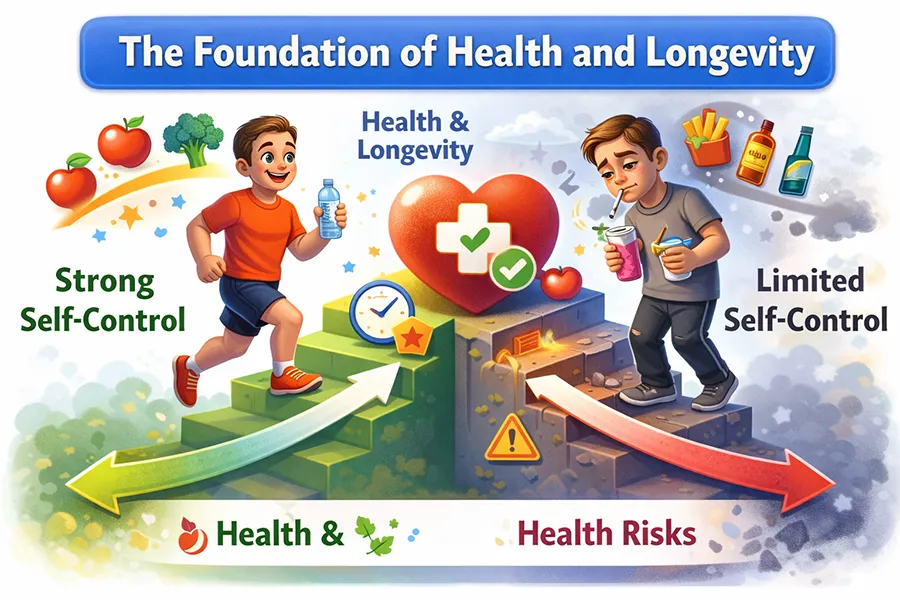
Many major health problems today are not due to a lack of medical knowledge, but to repeated struggles with self-control. Unhealthy eating, smoking, substance use, and risky choices all show how short-term urges can win over long-term health.
People with stronger self-control are much less likely to face problems like
- obesity,
- addiction, or
- long-term illnesses related to lifestyle.
They also tend to live longer and stay healthier. (Limited self-control and longevity, 2018) A study published in the Journal of Health Psychology found that individuals with high levels of self-control in their early years had a significantly lower risk of developing cardiovascular disease later in life.
Put simply, self-control helps protect our health by being consistent, not by being perfect.
2. Economic and professional stability
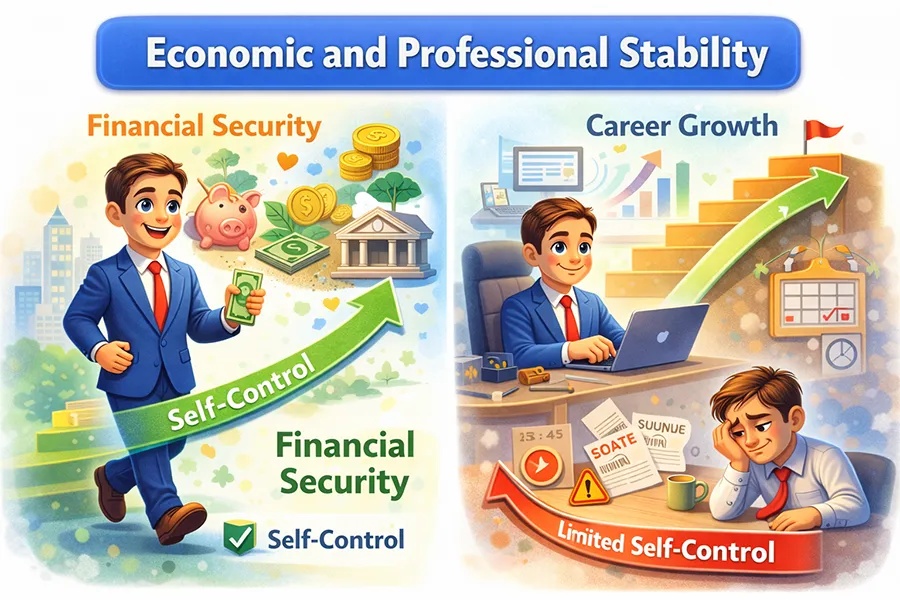
Willpower acts as a hidden force behind financial security and career growth. Long-term studies show that people with higher self-control as children often achieve better financial outcomes as adults, such as
- fewer debts,
- better saving habits, and
- more stable careers,
regardless of intelligence or background.
At work, self-control helps people be reliable, follow through, and stay focused over time. Those who keep going through boredom, frustration, and slow progress often do better than more talented peers who struggle to stay consistent. In the end, success usually comes from steady effort, not just short bursts of motivation.
3. Social and relationship health
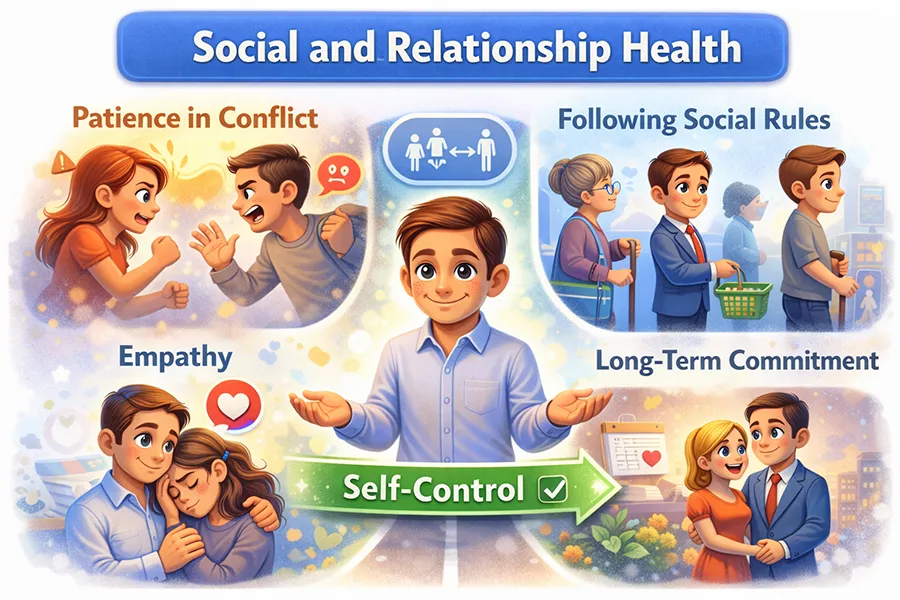
Cooperation is essential in life, and self-control gives us the inner brakes we need. It helps people pause before reacting, manage anger, respect boundaries, and follow social rules.
People with stronger self-control usually have more stable relationships, handle conflicts better, and earn more trust from others.
In romantic relationships, it helps with patience, empathy, and long-term commitment. In short, self-control makes people easier to live with and more dependable.
4. Mental well-being and resilience
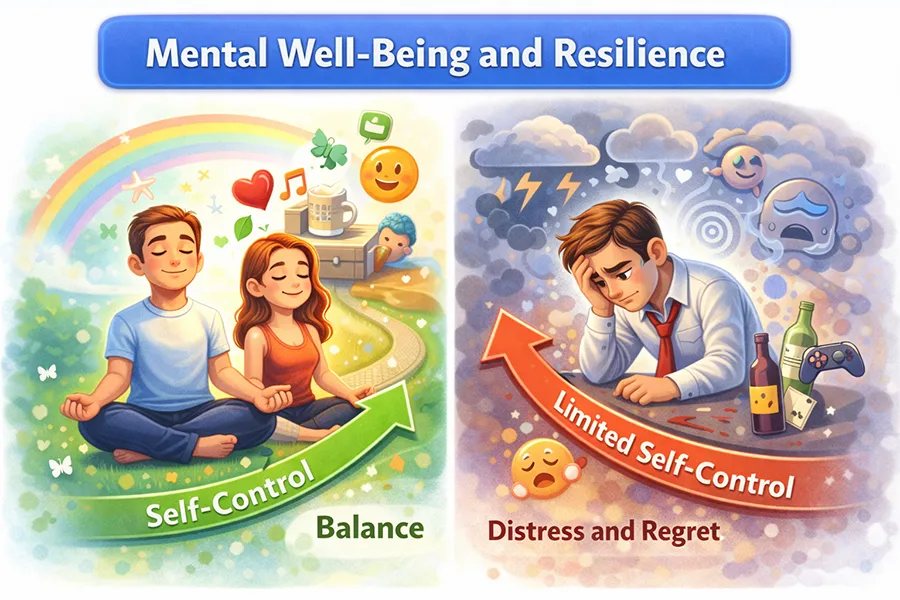
It might seem natural to think that always using self-control would make life strict or less enjoyable. In fact, the opposite is often true. People with more self-control usually feel happier and more satisfied with life. (Why are people with high self-control happier? The effect of trait self-control on happiness as mediated by regulatory focus, 2014, pp. 355-363)
This is because self-control is about balance, not harsh self-denial. It involves making mindful choices that align with one’s values, allowing for enjoyment while avoiding actions that could lead to regret. By focusing on moderation, individuals can have fulfilling experiences without overindulgence, leading to a more content and balanced lifestyle.
Stronger self-control also helps people cope better under pressure and makes them less likely to struggle with anxiety and depression. It does not remove stress, but it helps people recover more easily.
5. Surviving the digital environment
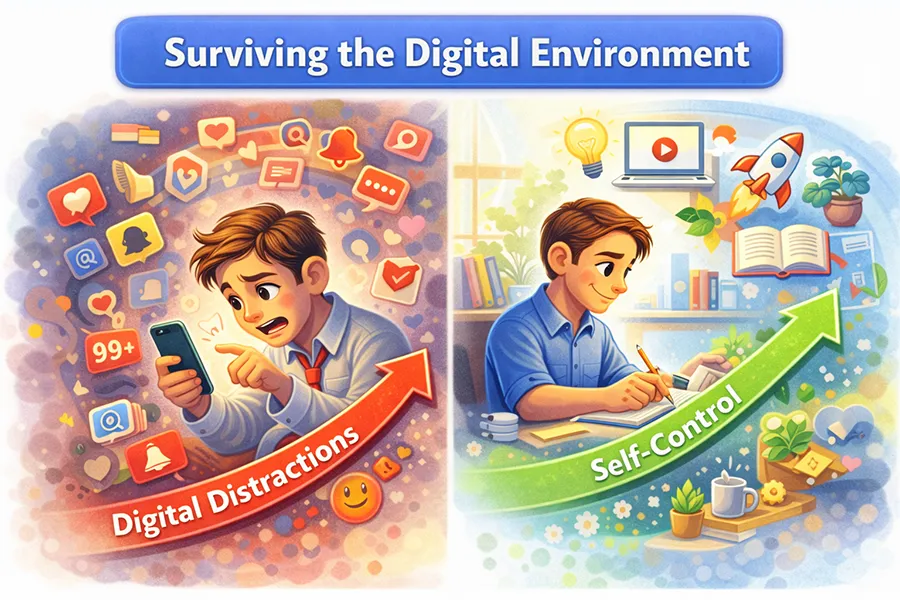
Modern digital platforms are built to capitalize on our impulses by offering constant new content, notifications, and changing rewards. This keeps pulling our attention away, making it harder to focus and creating habits of craving more.
In this setting, self-control is essential. It acts as a protective skill. Without it, our attention is often taken away; with it, people can reclaim their time, focus, and control over their minds.
Building self-control lets people choose where to focus their attention, such as on learning, creativity, and meaningful work, instead of getting lost in endless digital distractions.
How You Should Approach Improving Willpower
Building willpower and self-control helps you manage yourself better and live a steadier, less stressful life. The tricky part is that there isn’t one perfect method that works for everyone.
Willpower gets stronger when you know your weak spots and use proven strategies that suit you. Before you pick methods that fit your life, it’s helpful to learn the basics. Seeing the big picture makes it easier to improve.
In general, building willpower and self-control comes down to two main things:
- Changing how you think about willpower
- Strengthening the systems that support it
Change your mindset about willpower and self-control
Willpower is a skill, not a trait
You aren’t simply born with or without willpower. It’s a skill you can train, just like attention or managing your emotions. Studies show that self-control gets better with practice and the right support.
Progress can be slow, and sometimes it might seem like you’re not getting anywhere. That’s normal. Learning any skill usually doesn’t happen in a straight line. What counts most is sticking with it over time, not quick results.
Do not take failures personally
Willpower isn’t meant to work all the time. Things like stress, tiredness, emotions, and your surroundings all play a part. Failing once or even many times doesn’t mean you’re weak. It just shows that willpower can be fragile.
Instead of self-blame, treat failures as information:
- What caused the lapse?
- What conditions made control harder?
- What can be adjusted next time?
Bouncing back quickly matters more than never failing. Building willpower is a lot like how toddlers learn to walk—falling down is part of it. The only real setback is giving up.
Willpower depends on other mental skills
Willpower doesn’t work by itself. It relies on other mental skills, such as:
- Attention and focus help you notice impulses and distractions early.
- Emotional regulation reduces internal noise, making self-control easier.
- Mindfulness increases awareness before impulses gain strength.
- Habits and routines reduce the need for willpower.
When these skills are weak, using willpower feels tiring. When they’re strong, self-control feels easier—not because you’re trying harder, but because your mind has the support it needs.
Empower willpower and self-control
Support them with lifestyle choices
Your physical state has a big impact on willpower. Not getting enough sleep, eating poorly, being dehydrated, or feeling mentally worn out all make self-control harder.
A well-rested brain is better at holding back impulses. Because self-control takes energy, it’s important to protect that energy by:
- Prioritize sleep
- Eat regularly and sensibly.
- Stay hydrated
- Reduce unnecessary mental overload.
Lifestyle can’t replace willpower, but it does affect how strong or weak your willpower feels.
Have a clear, personalized goal
A clear goal is like having a destination on a map. Without one, it’s hard to know when to change course. Don’t settle for vague or outside goals—make them personal and meaningful. When your goal is clear, you can plan for challenges ahead of time, which helps you stay in control for the long run.
Resolve internal conflicts quickly
Even people with great self-control sometimes struggle to balance what they want with what they should do. The main difference is how quickly they act.
If you spend too long debating with yourself, your impulses usually win because your conscious mind gets tired faster. When you know what to do, act right away.
Connect your decisions straight to action. This helps your brain stop impulses before they get stronger.
Example:
If you want to scroll on your phone at bedtime, make a quick decision, turn it off, and close your eyes without overthinking it. Doing this over and over helps turn self-control into a habit.
Develop perseverance
Do hard things even when you don’t feel like it. Pushing through resistance, whether it’s for exercise, studying, or work, helps your brain get used to effort. It rewires your brain physically.
Your brain gets used to what you practice often. Over time, tough tasks feel easier and more natural. Sticking with it helps you resist impulses in the long run.
Offload self-control into habits
Daily life demands attention, problem-solving, and decision-making. Relying on willpower for everything is unrealistic. Use willpower initially to build habits. Once behaviors become automatic, self-control is no longer required. (Neal et al., 2013)
Start small:
- Build one habit at a time.
- Avoid overwhelming the system.
- Increase difficulty gradually
When habits take care of your daily routines, you free up mental energy for bigger goals. This is how lasting self-control helps you grow over time. With every goal achieved effortlessly, you’re carving a path towards a future where your best self thrives.
References
Frequently Asked Questions (FAQs)


 Willpower shows up in two main ways:
 After a long day, a person who wants to keep a healthy weight sees a sugary piece of cake in the kitchen. Nothing is making them eat it, but their mind is tired, stressed, and looking for comfort.
 Someone is working on an important task when notifications, messages, and the urge to check social media pop up. Each distraction gives a small feeling of reward and makes it harder to focus.
 During an argument, emotions can rise fast. Anger or feeling defensive can make someone want to react right away by raising their voice, interrupting, or saying something they might regret.
 For example, you might have to choose between eating a piece of cake now or sticking to your goal of managing your weight.
 It brings up strong memories of pleasure, like the taste of cake, the comfort, and the quick satisfaction. These signals are fast, emotional, and often come from habit.
 As this inner conflict arises, another brain area, the anterior cingulate cortex (ACC), becomes active. Its job is to watch for conflict and notice when different systems are competing. (Kerns et al., 2004, pp. 1023-1026)
 In the cake example, effective action might include:
 This happens because willpower is not a single force. It is a conflict between two systems:
 Because willpower is fragile and depends on their state of mind, strong-willed people do not use it as their main tool. Instead, they try to avoid temptation before it even shows up.
 Many major health problems today are not due to a lack of medical knowledge, but to repeated struggles with self-control. Unhealthy eating, smoking, substance use, and risky choices all show how short-term urges can win over long-term health.
 Willpower acts as a hidden force behind financial security and career growth. Long-term studies show that people with higher self-control as children often achieve better financial outcomes as adults, such as
 Cooperation is essential in life, and self-control gives us the inner brakes we need. It helps people pause before reacting, manage anger, respect boundaries, and follow social rules.
 It might seem natural to think that always using self-control would make life strict or less enjoyable. In fact, the opposite is often true. People with more self-control usually feel happier and more satisfied with life. (Why are people with high self-control happier? The effect of trait self-control on happiness as mediated by regulatory focus, 2014, pp. 355-363)
 Modern digital platforms are built to capitalize on our impulses by offering constant new content, notifications, and changing rewards. This keeps pulling our attention away, making it harder to focus and creating habits of craving more.
 Do hard things even when you don’t feel like it. Pushing through resistance, whether it’s for exercise, studying, or work, helps your brain get used to effort. It rewires your brain physically.