Attention, focus, and concentration are somewhat similar concepts, but each has its own role. People often mix them up, but if you look more closely, you can see the mental processes behind them are different.
Attention means being generally aware. Focus is when you direct that awareness to something specific. Concentration is what helps you keep your attention and focus steady. These three work together and support each other. When you understand how each one works, you may start to see your own focus and concentration differently in daily life.
We’ll take a closer look at what these terms mean from both psychology and neuroscience viewpoints.
We’ll explore:
- How they are different.
- How they work together.
- What a flow state is.
- Attention means being broadly aware. It lets you notice what’s going on around you without much effort.
- Focus is when you choose something on purpose. It means narrowing your attention to one thing, which takes mental effort.
- Concentration is keeping your focus steady for a longer time. It helps you stay on task and automatically blocks distractions.
- You can pay attention to several things at once, but if you try to focus on more than one thing, you lose depth.
- Flow happens when your attention is narrow, your focus stays steady, and concentrating feels easy.
Attention – The Brain’s Spotlight
Everyone needs and wants attention. Your teacher, partner, or child may have asked you to pay attention. But how can you explain that you were already paying attention if you don’t know what real attention is?
What is Attention?
Attention is how your mind helps you notice some things while ignoring others. It works like a spotlight, focusing on one part of your surroundings and making the rest less noticeable.
When you focus your attention on something, your senses tune in to it. They send your brain information about what’s happening. In short, attention means being aware of specific details or situations.
What happens when you pay attention?
When you pay attention to something, you become more aware of it. Your eyes, ears, and body focus on picking up information about it. You notice what’s happening with that thing, and other things fade into the background. That’s why you might not hear your name if you’re deep in conversation.
 Imagine reading a text on your phone in a busy hospital hallway. People are talking, carts are moving, and machines are beeping. But once you focus on your message, all that noise seems to fade. You might still hear it, but your brain stops paying attention. Your mind is focused on your phone screen.
That’s how attention works in daily life. It’s like shining a spotlight on one thing and letting everything else fade into the background.
As early psychologist William James described over a century ago, attention is the mind “taking possession of one out of several simultaneously possible objects or trains of thought” and withdrawing from the others.
Can you pay attention to several things at once?
Yes, but only to a certain point. The brain can use something called divided attention, which means being aware of more than one task or thing at once.
For example, if you read a book while waiting for a train, most of your attention is on the book, but you still notice what’s happening around you. You might hear announcements, footsteps, or the train arriving, even if you’re not trying to. This is divided attention in action.
Divided attention doesn’t go well with focus. You can’t fully focus on both things at once. Instead, your brain quickly switches between them, which makes it feel like you’re doing both at the same time.
People often use divided attention when they multitask, but it doesn’t work perfectly. Since our mental energy is limited, trying to do several things at once can slow us down, make us less accurate, and cause more mistakes.
If you get used to constantly switching tasks or dealing with frequent digital interruptions, it can harm your brain over time. This habit makes it harder to pay attention for long periods and to maintain deep focus.
Now that we know how attention works and what its limits are, let’s look at focus—how we choose where to direct our mental energy.
Focus – Choosing Where to Direct Attention
What is focus?
Focus means choosing one thing to pay attention to out of everything around you. It helps guide your thoughts to what is most important, much like a laser within a broader field of attention.
As you start to focus, your attention narrows. You connect more with certain information, and less essential details fade into the background. This helps you notice only what matters, making your thinking clearer and more directed.
Attention vs Focus
Attention often happens on its own, without any effort. Focus is different—it usually takes a conscious decision and mental effort. Attention first picks up information, and then focus decides what to work with.
Picture yourself waiting at a train station. Your attention is wide, and you notice many things at once: the sound of engines, people moving, announcements, and activity around you. You are not listening closely—your brain is just taking in the environment. When you hear a train coming, your attention is caught by that sound without any effort.
Now you start to focus. You listen carefully to the announcement to find out if it’s your train. Your mind narrows in, and other sounds fade away. You might not even notice people talking nearby or someone calling your name.
This change highlights the main difference:
- Attention is wide and happens passively.
- Focus is narrow and takes effort.
You can shift your focus between things your attention has already noticed. At the station, you might focus on the announcement, then the train number, then the platform sign. Each time, attention gives you choices, and focus picks one.
Even when you are focused, attention keeps working in the background. You might still notice sudden movements, loud sounds, or a whistle. Attention can track many things through different senses simultaneously.
But you can’t split your focus.
You can’t intensely focus on two things at once. Focus can’t be spread out. It works like a single beam rather than a floodlight because your brain has limited resources for deep focus and can handle only one task at a time.
That’s why true multitasking doesn’t exist.
Next, we’ll look at why focus takes more energy and what happens in your brain when you try to split it.
Why you can’t focus on two things at once
Focus works differently from attention. For instance, you can’t focus on your imagination while listening to your friend talk. That’s why you might get called out for daydreaming in class.
Focus takes a lot of mental effort. It relies on conscious processing, and your brain can only handle one stream of information at a time. You bring one set of information into your working memory, connect ideas, and build a flow of thoughts. If you try to focus on something else, you lose track of what you were thinking about before.
This explains why multitasking doesn’t work well. When you multitask, you have to keep switching your focus between tasks rather than truly doing both at once.
Research by Stanford’s Clifford Nass found that switching tasks can reduce productivity by up to 40%, suggesting that splitting your focus can significantly hurt your performance.
Knowing why multitasking doesn’t work leads us to concentration. It is your ability to maintain steady attention and focus over time, even in the face of many distractions.
Concentration – Holding Attention and Filtering Distractions
Concentration means maintaining your attention on one task for a set period of time while ignoring distractions. It is the skill of staying focused on the same thing for a while.
Concentration has two parts: maintaining your focus and blocking distractions. When you are deeply focused, your brain begins to ignore what is happening around you, helping you stay on task. This is why intense concentration is hard to break.
When you practice deep concentration, you can reach a flow state. In this state, your creativity and productivity increase a lot.
How Attention, Focus, and Concentration Work Together
Our goal is steady concentration: it begins with attention, then focus, then sustained effort. These three skills are interconnected.
Attention is the foundation for focus
You need to pay attention before you can focus. Attention helps you understand what’s happening around you. Focus then takes that attention and zooms in on one thing to see it more clearly.
When your attention is spread out, it’s harder to focus. There are more things to ignore, so your brain has to work harder to block out distractions.
Most people notice this effect when they feel afraid or stressed.
When you feel threatened, your brain goes into fight-or-flight mode. Your attention widens to look for danger from every direction. You start noticing movements, sounds, and changes around you. In this state, it’s hard to focus on one thing because your attention is busy looking out for anything that might be important for survival.
On the other hand, when your attention is more focused, it’s easier to concentrate.,
Imagine attention as a flashlight with a beam you can adjust. When the beam is wide, the light spreads out and it’s harder to see details. When you narrow the beam, the light gets brighter, and you can see things more clearly. Focus works the same way—narrowing your attention helps you see things more clearly.
Even if your attention is spread out, you can still focus, but it takes more effort. As you focus, your brain gradually tunes out distractions, and your attention narrows.
If you stop paying attention, you lose focus, too, since focus needs attention to work. But if you lose focus, it doesn’t always mean you’ve lost attention. Your attention can still stay on the same general topic unless something else grabs it.
In short, attention creates the setting, and focus is what happens within it.
Concentration builds on focus
Attention provides the ground. Focus builds the stage. Concentration occurs when the stage is steady. If the foundation or stage is weak, concentration will not last.
Focus means engaging deeply with something. It takes effort and involves purposeful thinking. When you focus, your attention narrows, and distractions lessen, but at first, this filtering is not complete.
At first, focusing requires constant effort. Your attention naturally drifts toward distractions. Each time it wanders, you must actively bring it back. This repeated redirection is part of the focus. Over time, the brain starts to recognize what truly matters and what does not.
As you keep practicing, your brain starts to filter out distractions on its own. This automatic filtering is part of concentration.
So, you cannot force concentration directly. You start by focusing, and once your brain learns the pattern, it handles much of the work for you.
Mindfulness meditation shows this process clearly.
When you begin, your attention frequently drifts to unrelated thoughts. Each time, you gently bring it back to the breath. This requires conscious effort. But as concentration deepens, attention naturally settles on the breath. Thoughts and external stimuli fade without effort. You are no longer actively managing the process. The brain does it for you.
Since concentration becomes automatic, it uses less mental energy over time. That is why staying focused for a long time can feel calm and refreshing, not tiring.
To sum up:
Attention opens your awareness.
Focus guides your attention.
Concentration helps you stay deep in the task.
Once you reach this depth, it often feels surprisingly easy.
What happens when you shift your focus?
Think of attention as the ground and focus as the stage. To move the stage, you have to move the ground first. You can’t change your focus without first shifting your attention. When your focus moves to something new, your attention has already gone there, even if just for a moment.
Picture yourself talking with a friend at a restaurant. Suddenly, you hear a loud noise behind you. Right away, you turn your head and focus on where the sound came from.
Notice the order of events. Before you looked, you were already aware of the noise. That awareness happened on its own. Your attention moved first, and then you focused when you looked and tried to figure out what made the sound.
This order always stays the same:
attention notices
focus chooses
Short shifts in focus aren’t a problem if you catch them quickly. They might make your concentration a little weaker, but they won’t ruin it. In fact, when you’re first learning to focus, making these minor corrections is important. As you get better at concentrating, it becomes easier to automatically ignore distractions.
Think about studying. You’re reading a paragraph and fully focused. Suddenly, you hear a notification. Your attention quickly notices it, but before your focus shifts away, you decide to ignore the sound and go back to your reading. Every time you do this, your concentration gets stronger.
At first, this takes effort. Over time, your brain learns what to ignore and what to pay attention to. Your focus comes back faster, your attention narrows more easily, and it gets easier to concentrate without having to think about it.
In short, shifting your focus always starts with attention. But when you choose not to follow every distraction, that’s how your concentration gets stronger.
What is the “Flow State”
When you concentrate intensely, it’s easier to stay focused and ignore distractions. This kind of focus narrows your attention and can lead to a feeling of floating. In this state, you may feel more efficient, productive, creative, and calm. If your focus slips, though, this feeling usually fades quickly.
Flow state happens when you feel in control, fulfilled, and wholly absorbed in what you’re doing.
In flow state, your attention narrows, and your focus deepens. Distractions are filtered out almost automatically. Once you reach this level of concentration, it’s hard to break because it starts to feel effortless.
Reaching flow state often isn’t easy. You need to be able to filter out distractions without thinking about it. This usually comes from practicing deep focus and maintaining steady attention over time. Flow is something you build as a habit, not something you can force in the moment.
Wrap Up
Attention, focus, and concentration are mental skills that are connected, but each one has its own job. Attention acts like a spotlight, helping you notice what matters and ignore the rest. Focus is about deciding what to look at within that spotlight. Concentration enables you to maintain your focus and block out distractions.
These three skills work together to affect how you learn, take in information, and stay involved in everyday activities. That’s why it helps to know how they connect.
5 Practical Ways to Support Concentration
These aren’t training programs or strict routines. They’re small changes that fit with the way our attention and focus naturally work.
Work in 20 to 30 minute blocks of focused time
Short, timed work sessions help prevent mental fatigue. They keep your attention from wandering and make it easier to stay focused without feeling strained.
Cut down on sensory distractions
A calm, uncluttered space—both visually and digitally—makes it easier to focus. With fewer distractions, your brain can devote more energy to concentration.
Take a minute to reset with slow breathing
Just a minute of slow, steady breathing can help calm your body. This makes it easier to regain your focus after an interruption.
Pick one thing to focus on before you start
Before you begin, decide precisely what you want to focus on. This simple step helps keep your attention steady and stops your mind from jumping around.
Give yourself short breaks to recover
After 40 to 50 minutes of work, stand up, stretch, or take a quick walk. These short breaks help your mind reset and make it easier to keep concentrating.
References
Frequently Asked Questions (FAQs)


 Imagine reading a text on your phone in a busy hospital hallway. People are talking, carts are moving, and machines are beeping. But once you focus on your message, all that noise seems to fade. You might still hear it, but your brain stops paying attention. Your mind is focused on your phone screen.
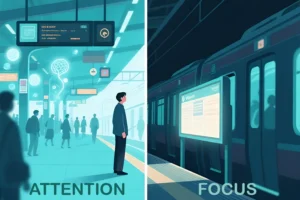 Picture yourself waiting at a train station. Your attention is wide, and you notice many things at once: the sound of engines, people moving, announcements, and activity around you. You are not listening closely—your brain is just taking in the environment. When you hear a train coming, your attention is caught by that sound without any effort.
 Concentration means maintaining your attention on one task for a set period of time while ignoring distractions. It is the skill of staying focused on the same thing for a while.