
Understanding Attention and Focus: How They Work and Why They Matter
- Last Updated: January,2026

Imagine your mind wandering for a second, then noticing the light from your buzzing phone. In just a few moments, notifications grab your attention. This happens for a reason. Even these small moments are shaped by the brain’s attention and focus systems, which are always deciding where your mental energy goes.
You rely on attention and focus all day long, whether you’re reacting to a sudden noise or trying to understand something new. These skills decide what you notice, think about, or ignore. Most of the time, they work quietly in the background, shaping your experience without you realizing it.
Learning how attention and focus work can change your perspective. It shows how the brain uses mental energy, why some distractions are so powerful, and how your daily habits affect these systems over time. This knowledge helps clear up common myths about focus and gives you a more practical view of how attention really works.
This article examines how attention and focus work in the brain and mind, why today’s world makes them harder to maintain, and how building stronger attention can support self-control, habits, mindfulness, and long-term well-being.
- Key Takeaways
- Attention and focus are not fixed parts of your personality.
- Attention determines what your brain focuses on.
- Attention is the gateway to learning, decision-making, and self-control.
- There are natural limits to how much attention your brain can handle.
- When you’re stressed, your attention shifts to what feels urgent or threatening.
- Attention is key to how the brain changes and adapts.
- For adults, real brain change needs steady and focused effort.
- Attention affects your daily life.
- When you understand how attention works, you can change your approach.
What Attention and Focus Really Are
Attention and focus guide your mind, much like a compass. Wherever your attention goes, your mental energy follows. Your brain puts effort into whatever seems most important at the time.
People often use attention, focus, and concentration as if they mean the same thing, so it’s helpful to define each one clearly.
What Is Attention
Attention is your general awareness of a situation. It acts like a mental spotlight, helping you notice what’s happening around you or in your own mind. You can think of attention as a receiver that picks up many different signals.
To understand what attention really is, see these 2 common example.
- In a lecture hall, your attention is on the stage, the teacher, and the board. You notice the whole setting.
- When you imagine your future, your attention turns inward. You notice your thoughts, images, and feelings about it.
Those are the attention in action. It’s broad and vague. It makes the playground the focus.
What Is Focus
Focus means narrowing your attention to one thing within a situation. It grabs fine details and lets you work on them. If attention is like a receiver, focus is the knob that tunes in to one signal over the others.
Focus helps you process things more deeply. It lets you understand, connect ideas, and remember them better.
- In the same lecture hall, attention helps you notice the whole class. Focus is paying close attention to what the teacher is explaining on the board and following along step by step.
That is your focus in action. It fulfils the prerequisite of concentration.
What Is Concentration
Concentration means keeping your focus steady over time. It happens when your attention stays on track, you block out distractions, and you stay focused long enough to do deep work.
Imagine you are typing a report and your phone buzzes with a new message, or a social media notification pops up on your computer screen. Successfully ignoring these distractions to continue working is what makes concentration powerful.
In everyday language:
Attention chooses the space.
Focus chooses the target.
Concentration keeps it there.
What Is Attention Span
Attention span refers to the duration for which an individual can maintain concentration before being distracted. Although this definition appears straightforward, attention span is not a fixed characteristic. It is influenced by several interacting factors, including:
- the complexity of the task,
- the perceived interest or relevance of the task,
- the individual’s capacity to regulate attention and suppress distractions, and
- the individual’s current physical and mental state.
Consequently, attention span can vary significantly across different situations, even within the same individual. This variability indicates that attention span alone is an inadequate measure of overall focusing ability, as it reflects temporary conditions rather than a stable capacity for attention.
(Read in depth about attention span in this insight: Attention Span: Why It Changes and How the Brain Shapes It)
Attention vs Focus vs Concentration
 Here’s a simple example:
You’re studying at your desk.
- Your attention is directed to the study context (your book, notes, and the topic).
- Your focus narrows onto a specific diagram or paragraph.
- Concentration is your ability to keep focusing and ignore distractions long enough to understand and remember what you’re studying.
These skills are closely related, but they aren’t the same. Knowing the difference can help you figure out what’s really going wrong when you feel like you can’t focus.
Now that you know the definitions, imagine embarking on a fascinating journey through your brain, meeting the neurons juggling your tasks. You’ll discover what happens when attention and focus work seamlessly and why, sometimes, in today’s fast-paced world, they don’t. This promises a thrilling voyage into the science behind your mind’s capabilities.
(You can read in-depth about how attention, focus, and concentration differ and how they work together here)
Neuroscience of Attention and Focus (Essential Overview)
Attention and focus come from different brain systems working together. What sets humans apart is our improved ability to control our attention on purpose. Knowing how this works helps us see what parts of attention we can improve and what limits we need to accept.
How the Brain Manages Attention
Attention mainly does two important things.
- Attention first spots what matters and lifts it into our awareness.
- Second, it blocks out things that don’t matter, which helps quiet our minds.
Only the information that passes through these steps can reach our deeper thinking, such as reasoning, learning, and decision-making. If we can’t sort or filter well, we lose focus, even if we’re trying hard.
The Attention Networks
Think of attention as a three-part relay team: no single part of the brain controls attention. Instead, three networks work together to manage it:
- The alerting system helps keep us awake and ready to notice things.
- The orienting system points our attention toward specific things.
- The executive control system helps us ignore distractions and stay focused on our goals.
When we have trouble focusing, it’s often because these systems are out of balance, not because we aren’t motivated. Everyday experiences, like feeling fatigued or exhausted after a long work shift, or mental health problems like ADHD, can illustrate this imbalance.
These conditions highlight how external factors and neurological wiring, rather than just a lack of willpower, can affect our ability to concentrate. Recognizing this can relieve self-judgment and foster understanding.
Brain Control and Chemical Balance
Parts of the brain that handle planning and monitoring help us stay focused and deal with distractions. These areas need the right chemical signals to work well, functioning much like volume knobs.
If the levels of chemicals such as dopamine, norepinephrine, and acetylcholine are out of balance, it’s like turning down the volume on focus. Consequently, our attention can become shaky, scattered, or tired.
How attention is being controlled
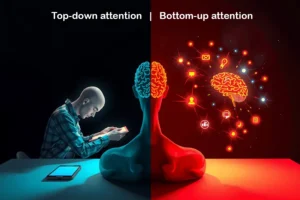 Sometimes you can choose where to focus your attention. This is called “deliberate attention (top-down attention).” Other times, your attention shifts on its own. This is called “automatic attention (bottom-up attention).”
Today’s world often pulls our attention automatically, which makes it harder to focus on purpose. Stress and tiredness make this even more likely.
Built-In Limits of Attention
Human attention possesses inherent limitations. Individuals can manage only one demanding task at a time, and working memory can retain only a limited amount of information. Apparent multitasking typically involves rapid task switching, which increases cognitive load and elevates the likelihood of errors.
These limitations can be demonstrated through a simple experiment: recalling a seven-digit phone number while composing an email. The resulting cognitive strain illustrates how rapidly working memory becomes overloaded when attention is divided.
These constraints do not represent personal shortcomings; rather, they are fundamental characteristics of how the brain allocates attention. This explains why multitasking consistently fails to enhance productivity, a topic examined in greater detail in “The Science behind Multitasking: Why It Fails and What Works Better.”
The Role of Attention and Focus in Neuroplasticity
Neuroplasticity means the brain can change in response to experience, and attention is key to this process. The brain strengthens pathways we often pay attention to, while those we ignore weaken. Simply put, attention guides what the brain changes.
Focus works alongside attention. When we focus, our brain activity becomes stronger, more organized, and more accurate. Attention chooses what pathways to engage; focus sharpens them into clearer signals. Attention starts the process, focus makes it efficient. Together, they enable the brain to change with purpose.
Neuroplasticity in Adults: Why Focus Matters More Over Time
Children’s brains can change quickly and in many ways, but adults’ brains are more selective and need more effort to change. This selectivity can be attributed to factors such as increased myelin density and stronger inhibitory circuits, which act like a “brake-pedal” system. In adults, the brain usually needs stronger, more sustained use of specific pathways for real change to occur.
So, just casually or half-heartedly paying attention is usually not enough. If our attention is scattered, the brain’s signals are weak and don’t last, making lasting change hard. Staying focused lets the brain use the same pathways again and again, which helps it adapt over time.
In simple terms:
- Attention opens the door to change.
- Focused, repeated engagement keeps the door open long enough for change to occur.
That’s why real learning, building skills, and changing habits as an adult depend so much on what we pay attention to and how well we keep our focus.
 Consider the story of Sarah, a 40-year-old professional who wanted to learn to play the piano. Initially, she found it daunting, with each practice session feeling repetitive and unproductive. However, she dedicated herself to practicing a simple scale every day for ten minutes, focusing intently on each note. Over the weeks, Sarah noticed improvement. Her disciplined attention and focus gradually built new neural pathways, allowing her hands to move more fluidly across the keys. This ‘bird by bird’ approach transformed a seemingly insurmountable task into a series of achievable steps, highlighting how sustained focus can lead to mastery.
For adults, the brain doesn’t change just by being exposed to something. It changes when we give steady attention and focus.
Why This Understanding Matters
When we understand attention as a biological system, our approach changes. Instead of just trying harder, we learn to work with how the brain manages its resources. Quick fixes don’t work because they ignore these limits. Lasting focus comes from steady routines and clear structure, which are covered more in other guides.
Sources & Studies
- Ageing Research Reviews (2025) – Neuroplasticity and Cognitive Enhancement
- Neuroscience & Biobehavioral Reviews (2013) – Structural Plasticity in Adult Learning
- Frontiers in Neuroscience (2014) – Adult Neuroplasticity: 40+ Years of Evidence
- Trends in Neurosciences (2020) – Myelin Plasticity in Learning and Memory
- Cortex (2024) – Adaptive Modes of Attention
- Spagna et al. (2015) – Executive Control of Attention (Frontiers in Psychology)
Types of Attention
We usually think of attention as one skill, but cognitive psychology sees it as several related abilities. Researchers in the early and mid-1900s tried to separate these parts and found that attention is a set of specialized processes that work together within an attention mechanism.
1. Selective Attention
Selective attention means focusing on important information and ignoring distractions, especially when there is a lot going on around you.
This selection can be:
- Deliberate, or top-down, attention is when you consciously choose what to focus on.
- Automatic, or bottom-up, attention happens when something grabs your focus without you realizing it.
When you lose deliberate control, automatic attention takes over, and your focus often drifts.
2. Sustained Attention
Sustained attention is the ability to stay focused on something for a long time, such as listening to a long lecture or driving on the highway.
This type of attention is what doctors and researchers usually measure, and it’s what people mean when they say they have a “short attention span.”
3. Divided Attention
Divided attention is when you try to do more than one thing at the same time.
It can work reasonably well when:
- The tasks use different senses, or
- One of the tasks is mostly automatic.
But when tasks need the same mental resources, like solving a math problem while listening closely, your performance drops a lot. That’s why real multitasking is mostly a myth.
4. Alternating Attention
Alternating attention is the ability to switch your focus between tasks that both require mental effort.
Every time you switch tasks, it takes a mental toll. Switching often makes it hard to focus deeply and can make you tired. What seems like multitasking is really just switching quickly between tasks, not doing them simultaneously. That explains why multitasking comes with a cost in productivity.
If you rely too much on switching between tasks, your brain gets better at switching but worse at staying focused.
5. Executive Attention
Executive attention is the highest level of attention. It helps you control your focus to reach your goals, such as:
- deliberately ignoring distractions,
- regulating conflicting thoughts and emotions, and
- resolving tension between immediate impulses and long-term goals.
Executive attention requires a lot of energy and can quickly become tired. You use it most when you need willpower and self-control. That’s why it’s hard to resist temptations and stick to your goals after a long, tiring day.
Sources & Studies
- (2016). Attention Span | Psych 256: Cognitive Psychology FA16 – 002. Penn State University.
- Lewis, C. M. & Gutzwiller, R. S. (2023). Examining post-error performance in a complex multitasking environment. Cognitive Research: Principles and Implications 8.
- Hayat, A., Akhtar, S. E., Yousaf, M. & Arshad, S. (2025). COGNITIVE LOAD OF MULTITASKING: HOW CONSTANT TASK-SWITCHING SHAPES ATTENTION SPAN. Annual Methodological Archive Research Review 3(9), pp. 594-615.
- (2024). Self-control and limited willpower: Current status of ego depletion theory and research. Psychological Bulletin 150(6), pp. 1001-1029.
Importance of Attention and Focus
In today’s digital world, it’s hard to find real focus and strong attention. When you understand why attention matters, you can tackle the problem differently. Focus isn’t just about getting more done; it also shapes how you think, make decisions, learn, and manage yourself.
1. To think clearly and deliberately
Attention is the thought filter in our brain. If we can’t filter our thoughts and stimuli well, distractions and random thoughts fill our minds. This makes it hard to think clearly because our mental space gets crowded instead of focused.
2. To think deeply and creatively
When we keep our attention on something, ideas stay in our minds long enough to explore and connect them. This deeper focus helps us solve problems, gain insights, and be creative. Without focus, our thinking stays shallow and scattered.
3. To learn and remember better
To learn well, we need to keep information in mind long enough for it to become a lasting memory. If our attention is scattered, we don’t understand or remember as much. Staying focused helps us learn faster and remember better.
4. To make better decisions
Making good decisions means ignoring what doesn’t matter and focusing on what does. Paying attention helps us compare options, think things through, and see the bigger picture. Often, attention matters more than intelligence when making choices.
5. To improve self-control
Our attention shapes how we act. If we keep our attention on our goals, we’re less likely to act on impulse. What looks like a lack of discipline is often just our attention getting pulled away at the wrong time.
6. To build and maintain habits
Building new habits takes careful attention at first. If we aren’t aware of what we’re doing and what triggers us, habits don’t stick. Habits become automatic later, but we need to pay attention when starting or changing them.
7. To regulate stress and emotions
When we can’t control our attention, we tend to worry and get stuck in negative thoughts. Focusing on what we’re doing helps break this cycle and keeps us in the present. Over time, steady attention helps us handle stress and emotions better.
8. To work productively without mental exhaustion
Focusing on one task at a time helps us avoid the extra effort that comes from switching between tasks. When our attention is scattered, we work harder but get less done and feel more tired. Staying focused helps us get more done with less effort.
9. To be present and mindful
Attention is at the heart of being aware. When we keep our attention steady, it’s easier to be present. Mindfulness isn’t just about relaxing—it’s about being able to focus on what’s happening right now.
10. To be better in relationships
Where we put our attention shapes how present and connected we are with others. Paying attention affects how well we listen, how aware we are of emotions, and the quality of our relationships.
Attention and focus serve different purposes depending on what daily life requires. Even though the same brain systems are involved, the way attention is used, challenged, or interrupted changes with each situation.
Why Focus Is Harder Than Ever
It’s harder to focus these days because the perfect conditions we need for steady attention aren’t as strong as they used to be. Our brains work hard to filter out distractions and keep our thoughts on track. When there are more distractions, or we feel tired or stressed, it’s much easier to lose focus.
Modern life encourages us to split our attention instead of focusing deeply. This is mostly because of two things: our surroundings and our mental state.
Environmental Pressures on Focus
Many places are full of things that grab our attention. Noise, people talking, feeling rushed, and lots of movement can break our train of thought before we can settle in. Even people who are very good at focusing can have trouble in busy or stressful places.
Studies show that open-office noise can cut productivity by up to 66%, illustrating just how distracting environmental factors can be.
Feeling uncomfortable, whether physical or mental, makes it even harder to pay attention. Imagine you’re sitting in a room with stale air and oppressive heat, sweating as you hunch over your desk, your back aching from poor posture. Suddenly, your phone vibrates with another notification, pulling your attention away from the task at hand.
Things like heat, humidity, bad posture, or feeling judged can distract us. On top of that, digital spaces are full of notifications and constant information, which keep pulling our focus away.
Mind States That Undermine Focus
How well we can focus also depends on how our mind is doing. Being tired, not sleeping well, feeling stressed or anxious, not drinking enough water, or having low energy all make it harder to pay attention. Mental health issues and not eating well can make it even worse.
Modern habits also make it harder to focus. Multitasking, switching between tasks, and scrolling without thinking all teach our brains to jump around rather than stay on one thing. Over time, this makes it even harder to focus for long periods.
Attention as the Foundation Skill
Attention is the base for all higher mental skills. Discipline, habits, and mindfulness rely on being able to keep goals in mind and notice choices as they come up. If it’s shaky, intentions fade before turning into action. What seems like poor willpower & self-control is often just attention, getting pulled away at the wrong time.
You can think of attention like a camera lens. If the lens is shaky, no matter how hard you try, the picture stays blurry. When you focus, your thinking gets clearer, your decisions become sharper, and your work feels more meaningful. Since attention is a skill you can train, making it stronger helps everything else you do.
READ FURTHER: Practical, Science-Based Path to Rewire Your Mind
Do You Have Poor Focus?
Poor focus isn’t always easy to spot. It can manifest in small ways rather than being a constant problem. Noticing these signs can help you figure out what’s going on before you try to fix it.
Some common signs of weak focus are:
- Having trouble sticking with one task, even if it’s important or interesting.
- Your mind often wanders off without you realizing it.
- You find yourself needing to start over again and again after being interrupted or taking a break.
- You get the basic idea but have a hard time thinking more deeply about it.
- You put in a lot of effort but don’t get much done, and end up feeling mentally tired.
- You get easily distracted by notifications or background noise.
- You have trouble remembering what you were about to do or keeping information in mind.
Most of the time, these signs show how your attention is affected by daily habits and interruptions. Noticing these patterns is the first step to building a stronger, steadier focus.
Can Attention and Focus Be Improved?
Neuroscience and psychology research shows that attention and focus can change over time. The brain stays adaptable throughout life, and its networks strengthen with repeated use.
Imagine a pianist who, after weeks of mindful listening exercises, begins to notice subtle nuances in pieces they previously thought they knew well.
This change illustrates how our attention, like muscles, can become stronger or weaker depending on how we use it. This adaptability highlights the brain’s natural plasticity in responding to practice.
Studies show that attention improves with regular, structured practice. Working in places with few distractions, doing tasks that need steady focus, and using routines that support attention all help. Consistency matters more than intensity, and it’s important to match how the brain naturally learns.
Many popular tips don’t work because they focus on the wrong things. Relying on willpower, quick productivity tricks, or constant stimulation ignores real limits, such as working memory and mental fatigue.
These methods might help for a short time, but they don’t lead to lasting improvement because they don’t change the brain’s systems.
Real improvement takes time. Attention grows little by little, not all at once. At first, you might just notice less mental effort, fewer slips, or a bit more clarity. Over time, these small gains add up, making attention a steadier skill.
Questions in Your Mind
Does concentration cause headaches?
Concentration on its own does not cause headaches. Headaches are usually related to mental fatigue, eye strain, dehydration, stress, or prolonged sitting while working. If you feel discomfort while focusing, it is likely due to physical stress, not the act of paying attention.
Does music boost focus?
Music can either help or hurt your focus, depending on what you are doing and your personal preferences. Background music may help with simple or repetitive tasks, but it can make complex thinking harder because it takes up some of your attention. Music with lyrics is especially distracting, since it uses the same parts of the brain you need for thinking.
Is attention span getting shorter?
Studies show that our attention is becoming more scattered, not necessarily shorter because of biology. Constant interruptions and switching between tasks teach our brains to move attention quickly, which makes it feel harder to focus for long periods. We still have the ability, but our habits have changed.
Is focusing ability affected by age?
Yes, but the effects are not the same for everyone. Some aspects of attention, such as how quickly you process information or how long you can focus, may weaken with age. On the other hand, skills like using experience to focus and managing emotions often get better, so many older adults can still focus well on important tasks.
Is there a connection between attention and autism?
Yes. People with autism often have different ways of paying attention, not just problems with attention. Many autistic people can focus deeply on things they care about, but may find it hard to switch their attention. These are differences in how attention is managed, not a single type of problem.
References
- McCallum, W. C. (2025). _Attention | Definition, Theories, Aspects, & Facts_. Britannica.
- (2024). _Attention and Perception_. University of Calicut School of Distance Education.
- Pennsylvania State University. (2021). Attention span. Psych 256: Cognitive Psychology.
- Cowan, N., Bao, C., Bishop-Chrzanowski, B. M., Costa, A. N., Greene, N. R., Guitard, D., Li, C., Musich, M. L. & Ünal, Z. E. (2024). _Attention Matters: How Orchestrating Attention May Relate to Classroom Learning_. Annual Review of Psychology 75.
- (2025). _Enhancing cognition: The power of neuroplasticity_. Ageing Research Reviews 112.
- (2013). _Structural Brain Plasticity in Adult Learning and Development_. Neuroscience & Biobehavioral Reviews 37(9), pp. 2296-2310.
- (2014). _Adult neuroplasticity: more than 40 years of research_. Frontiers in Neuroscience 8.
- (2020). _Myelin plasticity: sculpting circuits in learning and memory_. Trends in Neurosciences 43(12), pp. 1021-1032.
- (2024). _Adaptive modes of attention: Evidence from attentional networks_. Cortex 184, pp. 58-72.
- Spagna, A., Mackie, M. & Fan, J. (2015). _Supramodal executive control of attention_. Frontiers in Psychology 6.
- (2013). _Bottom-up and top-down attention: different processes and overlapping neural systems_. Elsevier B.V.
- Miller, E. K. & Buschman, T. J. (2015). _Working Memory Capacity: Limits on the Bandwidth of Cognition_. Daedalus 144(1), pp. 112-122.
- (2016). _Developing brain networks of attention_. Current Opinion in Psychology 8, pp. 1-6.
- Brace, R. (November 9, 2025). _The High Cost of Interruptions_. The Tigris Group.
- J., K., E., S. & S., K. (2021). _Flow and the dynamics of conscious thought_. Phenomenology and the Cognitive Sciences 21.
- (2021). _The Relationship Among Trait Mindfulness, Attention, and Working Memory in Junior School Students Under Different Stressful Situations_. Frontiers in Psychology 12.
- G., M., A., V. & S., C. (2014). _Do Interruptions Affect Quality of Work?_. Human-Computer Interaction 29(4), pp. 1-28.
- (2025). _Acute stress impairs decision-making at varying levels of decision complexity_. Journal of Experimental Psychology: General 154(1), pp. 1-15.
- (2023). _The Sound of Wellbeing, Engagement and Productivity_. I+S Design.
- (2011). _Component Processes of Executive Function—Mindfulness, Self-Control, and Working Memory—and Their Relationships with Mental and Behavioral Health_. Journal of Attention Disorders 15(8), pp. 649-660.
- (2023). _Strategic music listening and subjective perceptions: effects on attention and workload across task complexity levels_. Frontiers in Psychology.
- (2016). Attention Span | Psych 256: Cognitive Psychology FA16 – 002. Penn State University.
- Lewis, C. M. & Gutzwiller, R. S. (2023). Examining post-error performance in a complex multitasking environment. Cognitive Research: Principles and Implications 8.
- Hayat, A., Akhtar, S. E., Yousaf, M. & Arshad, S. (2025). COGNITIVE LOAD OF MULTITASKING: HOW CONSTANT TASK-SWITCHING SHAPES ATTENTION SPAN. Annual Methodological Archive Research Review 3(9), pp. 594-615.
- (2024). Self-control and limited willpower: Current status of ego depletion theory and research. Psychological Bulletin 150(6), pp. 1001-1029.